What would a dead star look like if someone could get close enough to see it clearly? For most white dwarfs, the answer would be fairly ordinary. But a study from the University of Warwick suggests that a small number would look very different from the rest.
The researchers found evidence of colors that aren’t usually associated with these stars. Their calculations included shades of green, pink and purple, even though white dwarfs generally get their name from their pale appearance.
The study was led by astrophysicist Mark Hollands and appeared in the journal RAS Techniques and Instruments. The team used information gathered from starlight to estimate how these objects would appear to human eyes.
A telescope can tell scientists a lot about the light arriving from a distant object. It can show which wavelengths are present and how strongly they are represented. The researchers took that information and worked out the colors that would result when viewed by a person.
The work also involved looking at a group of white dwarfs in the region surrounding Earth. There were 151 stars in that group, and almost all of them had colors close to what astronomers normally expect.
Just five looked different. Three fell into the pink category, while the other two appeared yellow. From those results, the scientists estimated that roughly three percent of white dwarfs could have unusual coloring.
These stars are the remains of objects that were once similar to our Sun. After their normal fuel supply is exhausted, the remaining matter is compressed into a much smaller body.
The conditions around that body can be quite different from those found around an ordinary star. In certain cases, the material above the surface becomes dense enough to change how light interacts with the elements present.
This helps explain why two stars with different atmospheric contents might not look alike, even when temperature alone would suggest a more familiar color.
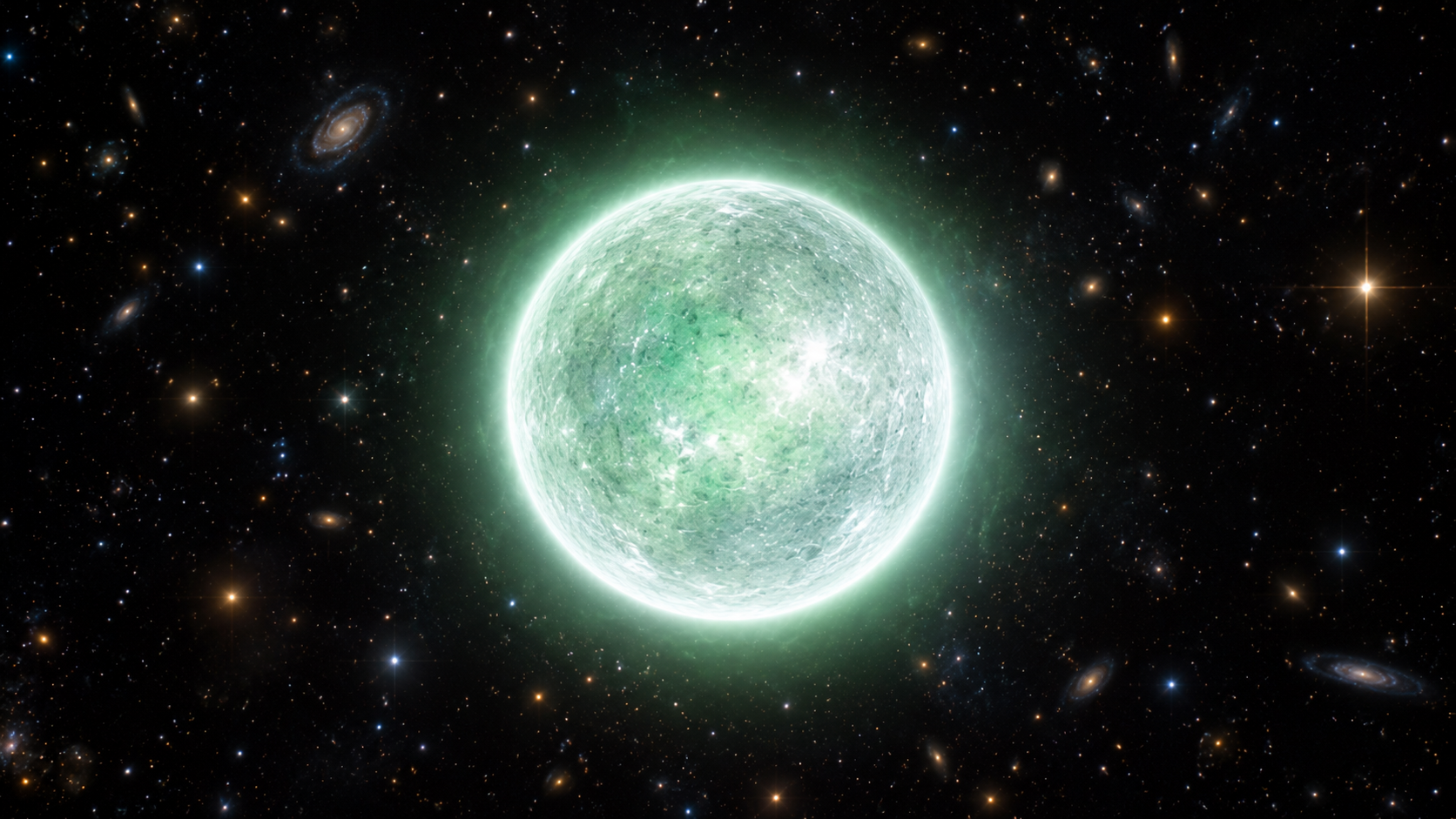
One of the objects examined by the team has the designation WD J1330+6435. Its predicted appearance is green, something researchers say hasn’t previously been established for another star.
The object has taken in material associated with its planetary system. Some of that material remains in the atmosphere, where it affects the light that can pass through. Sodium is one of the elements involved in producing the calculated color.
The team also studied an object designated WD J1011+2845. Unlike the green example, this star would have a much warmer-looking appearance, closer to a strong reddish pink.
Its color is connected to carbon that has moved outward from the star’s interior. The carbon affects the wavelengths reaching an observer, changing the overall appearance from what temperature alone might suggest.
Other white dwarfs have their own combinations of atmospheric materials. Some could appear closer to purple, while others might show a pale blue-green tint. These differences depend on how the substances around each star interact with its light.
The researchers also examined the color measurements for the nearby white dwarfs as a group. Their calculations placed the middle of the distribution in the white range, rather than blue.
That matters because hotter white dwarfs are easier to observe over long distances. They produce more light, so surveys that detect the brightest objects can include a larger share of blue-looking stars than exists in the nearby population.
This image is the property of The New Dispatch LLC and is not licenseable for external use without explicit written permission.