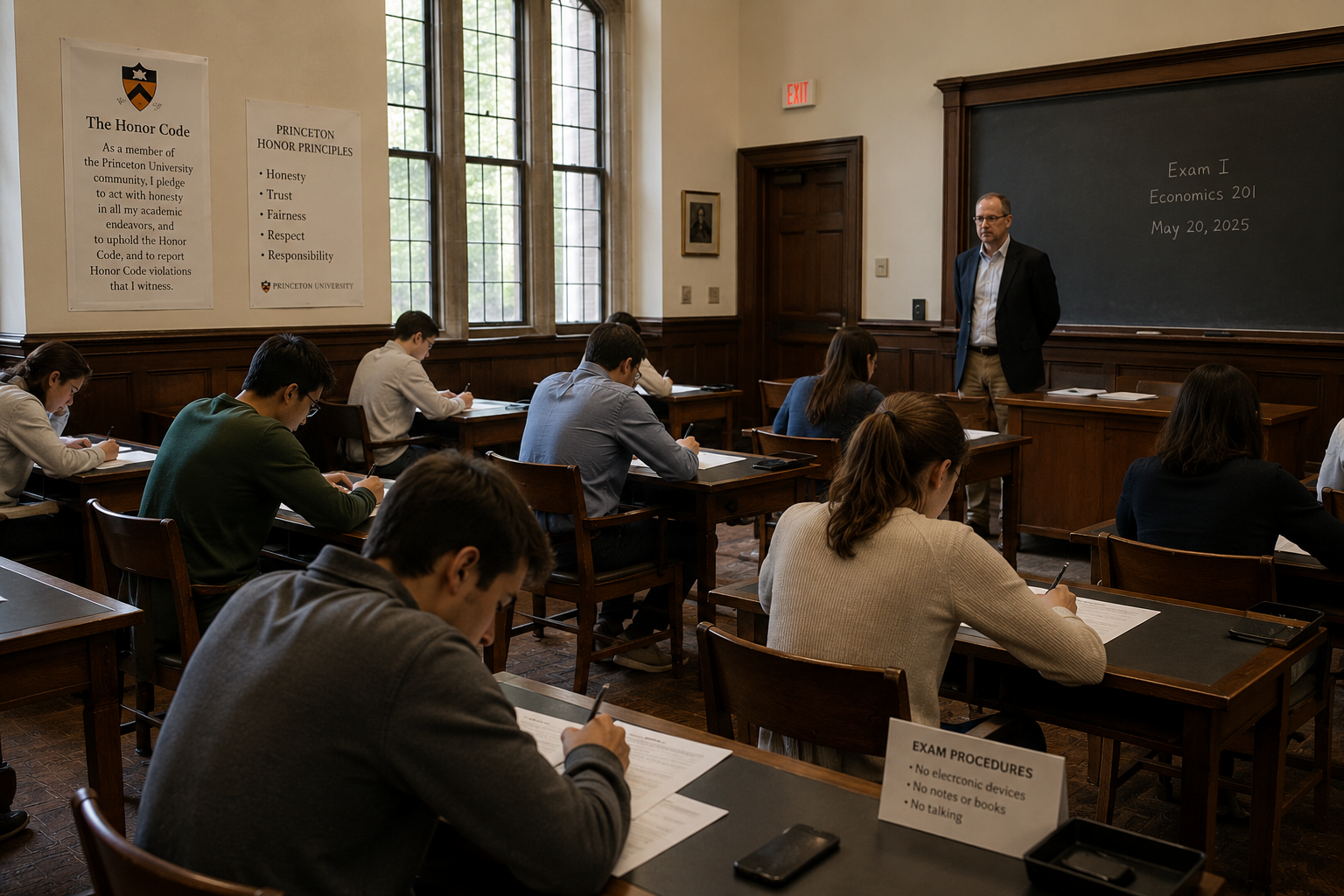
Princeton University will begin requiring proctors for all in-person exams starting July 1, ending a practice that has been part of the school’s honor system for more than 130 years. The decision comes after months of discussion about academic integrity and the growing use of artificial intelligence tools by students.
Faculty approved the policy Monday with only one opposing vote. Under the new rules, instructors will stay in exam rooms to observe students while they take tests. They are not supposed to interfere during exams, but if they see a possible Honor Code violation, they can document it and report it to Princeton’s student-run Honor Committee.
The university’s honor system dates back to 1893, when students pushed to eliminate proctors entirely and instead rely on trust and student accountability. Since then, Princeton students have pledged not only to avoid cheating themselves, but also to report classmates who violate the Honor Code. Faculty formally banned proctoring that same year. That ban stayed in place for 133 years.
School officials say AI tools and personal devices have changed the situation. According to a policy proposal from Dean of the College Michael Gordin, cheating has become harder for students to notice because generative AI can be accessed quietly on phones and other small devices during exams.
“If students alone are present in the examination room and students are unwilling to report, then there is no check against misconduct during assessments,” Gordin wrote in the proposal.
The document also said students have become more hesitant to report classmates directly. Anonymous reports have increased in recent years, partly because some students fear retaliation online, including doxxing or public shaming on social media. That concern came up repeatedly during discussions between faculty and student groups.
A 2025 survey conducted among Princeton seniors found that about 29.9% admitted to cheating on an assignment or exam at some point during college. Another 44.6% said they knew about Honor Code violations but chose not to report them. Only 0.4% said they had reported another student. The survey included responses from more than 500 seniors.
The proposal to bring back proctoring had already been approved unanimously by Princeton’s Committee on Examinations and Standing and the Faculty Advisory Committee on Policy before Monday’s final faculty vote. More details, including proctor-to-student ratios and monitoring guidelines, are still being worked out with faculty and student representatives.
The Honor Committee itself will not change under the new system. Hearings will still be student-led and confidential. Students accused of violations can present evidence, call witnesses, and work with Peer Representatives during the process. Penalties can range up to expulsion.
The shift at Princeton reflects a larger conversation happening at colleges across the country. Schools have been trying different approaches as AI becomes more common in classrooms and assignments. Some universities now use AI detection software, while others have updated academic integrity policies to clarify what kinds of AI use are allowed.
At Duke University, admissions officials stopped giving numerical ratings to applicant essays in 2024 because they no longer felt certain essays reflected students’ own writing. Essays are still reviewed, but the university changed how they are evaluated.
Jennifer Rubin, a senior researcher at the education research group Foundry10, said schools are dealing with uncertainty around AI use and academic honesty. She said proctoring may reduce some pressure around cheating concerns, though colleges will likely keep adjusting policies as AI tools continue spreading through education.
This image is the property of The New Dispatch LLC and is not licenseable for external use without explicit written permission.