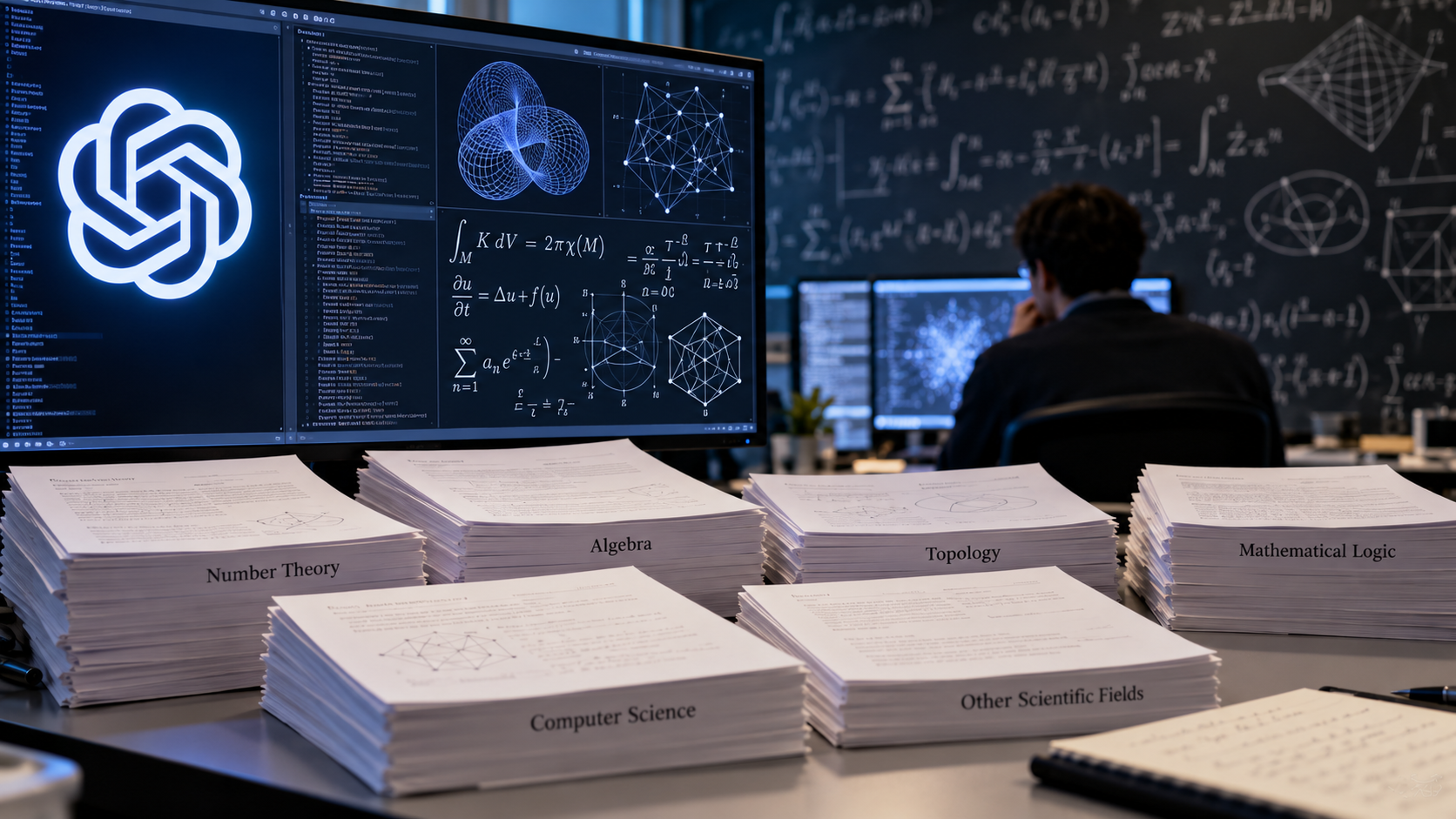
OpenAI released a large collection of mathematical research Tuesday, with an internal AI system producing results involving 377 problems across mathematics and other scientific fields. More than 700 papers were made public as part of the release, covering subjects such as number theory, algebra, topology, mathematical logic and computer science.
Some of the research reaches into problems that mathematicians have worked on for years. The collection includes work connected to three of the seven Millennium Prize Problems, which each carry a $1 million award for a successful solution.
The system responsible for the work is one of OpenAI’s internal frontier models and is not currently available to the public. OpenAI provided more information about the process for 10 of the results, saying a solution took roughly three hours of computing time on average.
This is not the first time the company has recently put AI to work on extremely difficult mathematics. OpenAI announced work involving the Navier-Stokes problem last month, and the latest research was produced by the same unreleased model.
Putting hundreds of results out at once does not mean mathematicians will immediately accept all of them. Researchers still have to examine the papers, determine whether the arguments hold up and look at how the AI arrived at its work.
That review is happening during a larger dispute over the role AI companies are beginning to play in mathematical research. One concern is where the contribution of existing human research ends and the AI system’s own work begins. That issue came up after OpenAI’s earlier Navier-Stokes announcement, when a researcher who had worked with Anthropic said unpublished work of his had been used by the model. OpenAI rejected the allegation.
Other mathematicians have raised broader concerns about using closed AI systems for research problems. More than two dozen Fields Medal recipients signed an open letter criticizing the practice, while an independent advisory group has recommended that companies stop testing advanced mathematics on proprietary models that researchers cannot access themselves.
OpenAI has been consulting with that advisory group, which operates through the Institute for Advanced Study in Princeton, New Jersey. The group recently issued recommendations intended to establish standards for AI-generated mathematical research, including clearer documentation, proper citations and papers that people can understand and evaluate.
The company says those recommendations influenced how the new material was presented, although it did not follow every recommendation. One clear difference remains that the AI system responsible for the research is still private, despite the group’s position against conducting this type of testing with inaccessible models.
The release now puts the hundreds of papers before mathematicians for examination. The advisory group said researchers will need to determine how well OpenAI followed its recommendations and then work through the findings before deciding where they fit within existing mathematical knowledge.
OpenAI has said it wants to eventually make the model responsible for the results available in a responsible way. No release date for that model was provided in the material accompanying the reports.
This image is the property of The New Dispatch LLC and is not licenseable for external use without explicit written permission.