Iran is preparing to take a more aggressive military approach as negotiations with the United States remain stalled, raising new questions about whether the months-long conflict can be brought to an end.
A senior Iranian official said Monday that the country is moving away from a mainly defensive strategy and toward what the official called a “fully offensive” policy. The change comes as diplomatic efforts have failed to produce a permanent agreement between Tehran and Washington.
Iran’s Islamic Revolutionary Guard Corps has sent a similar message. Brigadier General Yadollah Javani, the IRGC’s political deputy, said Iranian forces are prepared for “strategic surprises” and warned that opponents should not expect to catch the country unprepared.
The warning comes after Major General Ahmad Vahidi was appointed commander-in-chief of the IRGC. Vahidi has previously served as Iran’s defense minister and interior minister and is a veteran of the Iran-Iraq war. His new role reportedly places a strong focus on deterrence and responding to threats before they grow.
Much of the current dispute centers on the Strait of Hormuz. Attempts to restore regular oil tanker traffic through the waterway have stalled along with the wider peace process.
Iran has warned that the situation could become more tense if diplomacy does not produce results. A senior official said the country is prepared to make difficult decisions involving the strait and the surrounding region. The official also said Tehran could launch a “timely and precise” military operation against the U.S. naval blockade if negotiations fail.
Monday was supposed to be an important deadline for the two countries. A deal reached in June gave Washington and Tehran 60 days to work toward a permanent settlement, with an extension possible if both sides agreed to one.
The arrangement called for military operations to stop while the two governments worked through larger disputes. Iran’s nuclear program was one of the subjects expected to be part of those discussions.
The agreement started falling apart over a disagreement about the Strait of Hormuz. Tehran argued that part of the deal allowed Iran to manage the waterway, while Washington did not accept that interpretation. Fighting later resumed, and Iranian forces fired on vessels that Tehran said were traveling along routes without its approval.
President Donald Trump declared in early July that the agreement was “over.” Iranian officials have accused the United States of failing to meet its commitments.
Tehran is now preparing to give Washington a period of several weeks to carry out the agreement’s terms. According to the senior Iranian official, meeting those conditions would have to happen before further negotiations. Mediators are expected to pass Iran’s deadline to U.S. officials and governments in the region.
There is still another effort involving the Strait of Hormuz. Iran and Oman have been working on a plan for ships to travel through the waterway, and Iranian Foreign Affairs spokesperson Esmail Baghaei said the two sides have reached an understanding about the route ships could use.
Under details previously discussed, vessels would enter near the Iranian side and leave closer to Oman. Ships would not have to pay tolls or fees during the temporary arrangement.
Trump continued focusing on Iran’s nuclear program Monday, saying his main goal remains preventing Tehran from obtaining a nuclear weapon. He had also warned Americans days earlier that fuel prices could stay high because of the war while suggesting the United States could eventually claim the Strait of Hormuz as its territory.
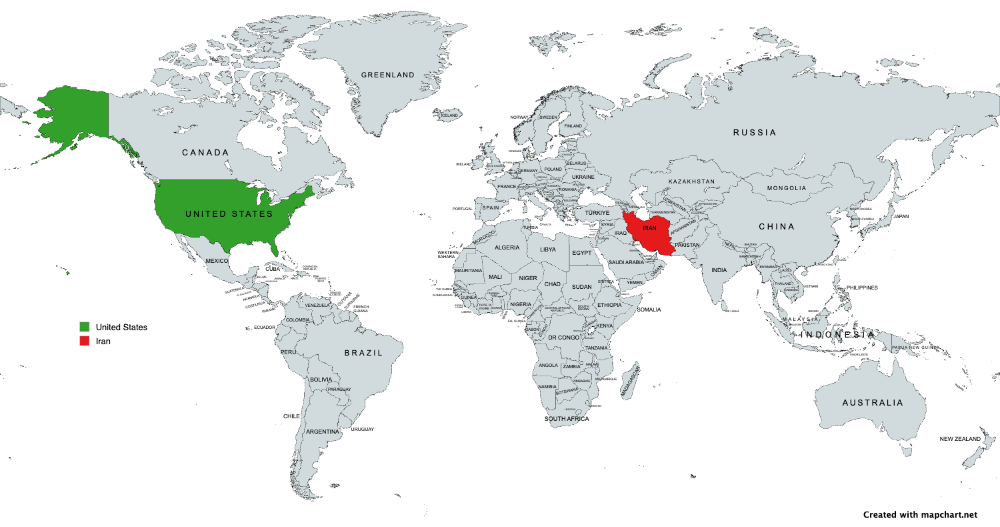
USA = Green
Iran = Red
Image is licensed under the Creative Commons Attribution-Share Alike 4.0 International license and was created using MapChart (https://mapchart.net).