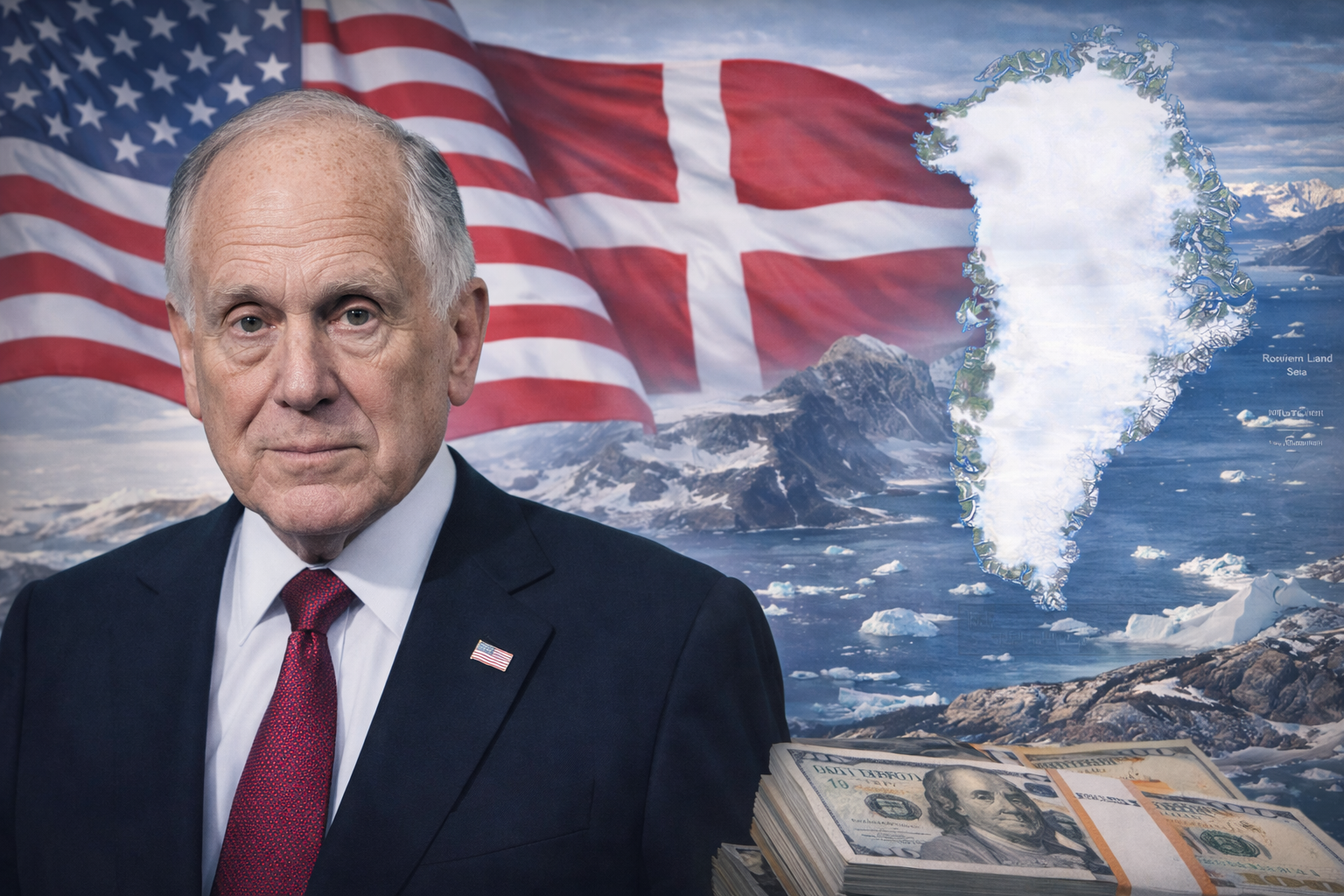
Ronald S. Lauder, heir to the Estée Lauder family fortune and a longtime acquaintance of Donald Trump, has been identified in several accounts as an early advocate of the idea that the United States should seek control of Greenland. According to former national security adviser John Bolton, Trump told him during his first term that a prominent businessman had suggested buying Greenland; Bolton later said that businessman was Lauder. Peter Baker and Susan Glasser likewise reported in their 2022 book The Divider that Lauder discussed the idea with Trump early in his presidency and offered to serve as a back channel to Denmark. That evidence supports attributing the idea to Lauder, though it is more precise to say he was reported to have been an early promoter of it rather than to state it as an undisputed fact.
Born on February 26, 1944, Lauder is the younger son of Estée and Joseph Lauder, founders of the cosmetics company that bears their name. He earned a bachelor’s degree in international business from the Wharton School of the University of Pennsylvania. After working in the family business, he entered government service in the Reagan administration, serving from 1983 to 1986 as Deputy Assistant Secretary of Defense for European and NATO affairs and then as U.S. ambassador to Austria from 1986 to 1987. He later ran unsuccessfully for mayor of New York City in 1989 as a Republican. Since 2007, he has served as president of the World Jewish Congress and has remained active in philanthropy, Jewish communal life, and Republican politics.
Lauder’s association with the Greenland idea appears to date to 2018, but the matter became public in 2019, when reporting revealed Trump’s interest in buying the island. Danish Prime Minister Mette Frederiksen rejected the notion at the time, saying Greenland was not for sale and calling the idea “absurd.” Trump later publicly floated the proposal during his first term and revived it around his return to office in late 2024 and early 2025, framing Greenland as vital to U.S. security and strategic influence in the Arctic.
Questions about Lauder’s motives intensified after reporting by Politiken and The Guardian linked him to investor groups involved in Greenlandic business projects. Those reports said he was among investors tied to ventures involving luxury bottled water exports and a hydropower-related development. Lauder has also publicly argued that Greenland is strategically important because of its rare earth resources, Arctic location, and relevance to competition with China and Russia. Those factors make it plausible that his interest combines geopolitical and commercial considerations.
That overlap is what makes Lauder’s role notable. A wealthy businessman with reported investments connected to Greenland also appears, according to Bolton and later reporting, to have helped place the territory on Trump’s agenda. Critics see that as a potential conflict-of-interest story. Supporters could counter that the strategic case for deeper U.S. involvement in Greenland exists independently of Lauder’s finances. What can be said with confidence is that Lauder was not just a bystander: he was a well-connected advocate whose views appear to have mattered inside Trump’s orbit.
As of April 2026, Greenland remains firmly opposed to being sold or absorbed by the United States, and Denmark has continued to reject that possibility. But Trump’s pressure campaign over Greenland has not disappeared, and current reporting indicates that the issue remains a live strategic dispute. In that sense, Lauder helped move Greenland from an improbable real-estate-style idea into a continuing argument about Arctic power, mineral wealth, and the role of private influence in U.S. foreign policy.
This image is the property of The New Dispatch LLC and is not licenseable for external use without explicit written permission.