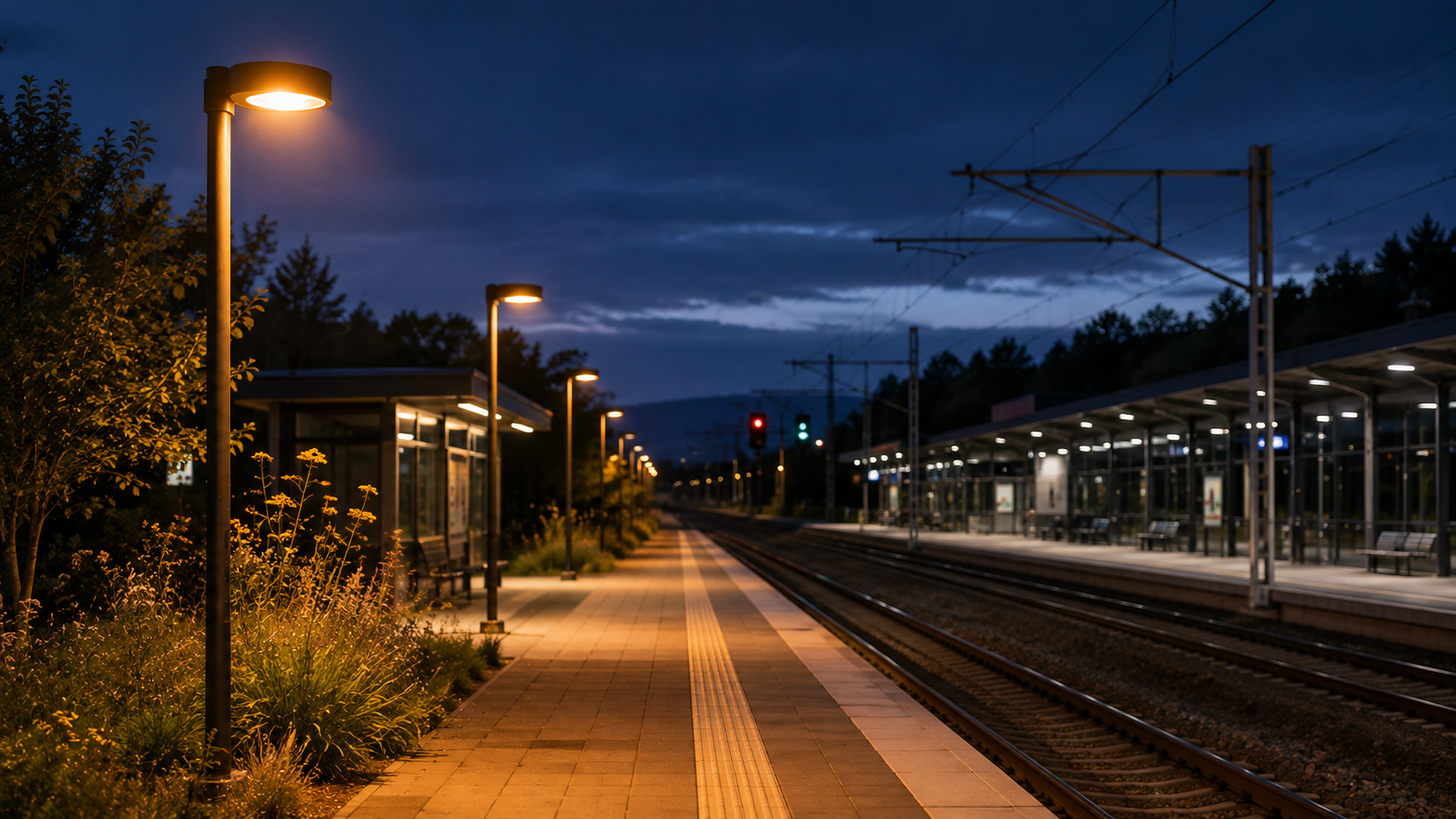
Researchers in Germany have found that changing the type of outdoor lights used at railway stations could help protect insects. Their study looked at how different lights attract flying insects during the night. The researchers tested three types of lights at six railway stations over two years, from 2023 to 2024. They compared warm amber LED lights (1800 K), yellow-orange high-pressure sodium lights (2000 K), and bright white LED lights (4000 K). The numbers in parentheses show the color temperature of the lights. Lower numbers produce warmer, more orange-colored light, while higher numbers produce brighter white light.
The researchers also included dark areas with no lights to see how insects behaved naturally. They used insect traps, AI image analysis, and DNA testing to measure how many insects were caught, how much they weighed, how many different species were found, and whether any rare or protected insects were present.
The results showed that all artificial lights attracted more insects than areas with no lighting. But the warm amber LED lights attracted the fewest insects out of all the lights that were tested. Compared with the other two light types, the amber LEDs reduced the number of insects by about 39 to 51 percent. They also lowered the total insect biomass by 51 to 77 percent and reduced the number of different insect species by about 11 to 23 percent.
The researchers also found that the yellow-orange high-pressure sodium lights and the bright white LED lights attracted about the same number of insects. This means that simply changing from one of those lights to the other may not help insects very much. The warm amber LED lights also attracted fewer rare and legally protected insect species than the other lights.
The team believes the amber lights worked better because they produce very little blue light. Many insects use blue light to help them find their way at night, so they are less attracted to lights that do not produce much of it.
Artificial light at night can cause many problems for insects. It can confuse them and interrupt important activities like feeding, mating, and moving around. It can also make them easier for predators to catch. Since more than 60 percent of invertebrates are active at night, lights along roads, railways, parks, and sidewalks can affect many different species.
The researchers said the study was strong because it took place in real outdoor conditions instead of a laboratory. It lasted for two years and used both AI image analysis and DNA testing to identify nearly 1,500 insect species.
The study also had some limits. It only measured flying insects at the height of the lights, and some outside factors, such as nearby lights and differences in habitats, could not be completely controlled. The researchers also measured how many insects were attracted to the lights, not whether insect populations increased or decreased over time.
Based on the results, all six railway stations in the study have already switched to warm amber LED lights. The researchers recommend using these lights whenever outdoor lighting is needed. They also suggest reducing unnecessary lighting at night and using features like dimmers, shields, and motion sensors to help protect insects even more.
This image is the property of The New Dispatch LLC and is not licenseable for external use without explicit written permission.