French President Emmanuel Macron has announced a plan to expand France’s nuclear arsenal and deepen cooperation with several European allies, presenting the move as part of a broader effort to strengthen Europe’s ability to defend itself in an increasingly tense global environment.
During a speech at a naval facility in Brittany that houses France’s nuclear submarine fleet, Macron introduced a new “forward deterrence” approach. The plan includes increasing the number of nuclear warheads in France’s stockpile and allowing nuclear-capable aircraft to be stationed temporarily in partner countries across Europe.
France currently maintains fewer than 300 nuclear warheads, a level that has remained largely unchanged since the end of the Cold War. Macron said the government will raise that number, although he did not specify how large the increase will be. The decision marks the first time in decades that France has chosen to expand its nuclear stockpile.
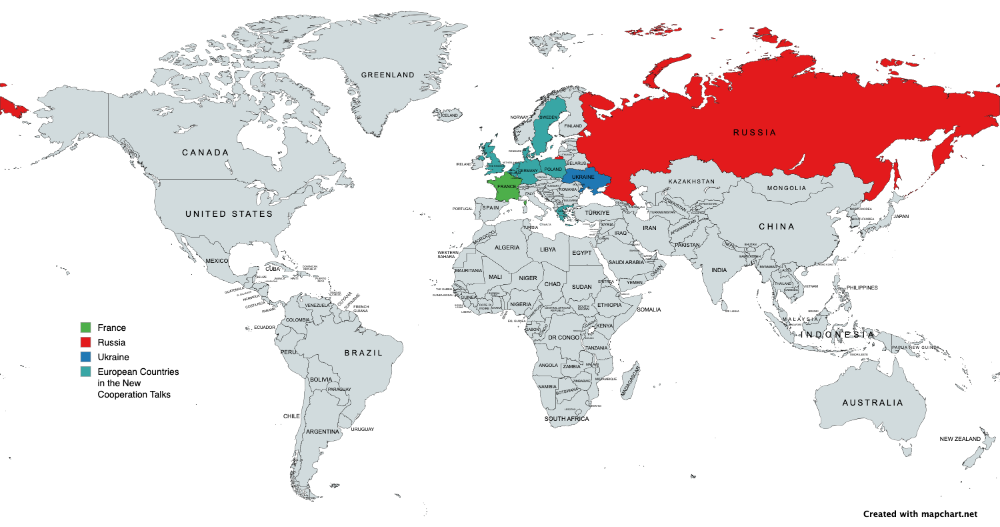
The strategy also opens the door for deeper coordination with European allies. According to Macron, discussions are already underway with eight countries — the United Kingdom, Germany, Poland, the Netherlands, Belgium, Greece, Sweden and Denmark — about their potential participation in exercises and planning linked to France’s nuclear deterrent.
Under the proposal, French aircraft capable of carrying nuclear weapons could be deployed temporarily to allied air bases. These deployments would not transfer control of the weapons to partner nations, however. Macron stressed that the authority to launch nuclear weapons will remain exclusively with the French president. Under France’s constitution, the head of state acts as commander-in-chief of the armed forces and retains sole responsibility for decisions involving nuclear use.
European leaders have increasingly debated the future of the continent’s defense arrangements. For decades, NATO’s nuclear deterrence has relied heavily on American capabilities. In recent years, concerns have grown in some European capitals about the durability of U.S. security commitments, particularly as global conflicts expand and Washington reassesses its strategic priorities.
Macron argued that these developments mean Europe must take a larger role in ensuring its own security. France, which became the European Union’s only nuclear-armed member after the United Kingdom left the bloc in 2020, has long maintained an independent nuclear force designed to deter attacks against the nation and its interests.
The new policy would also allow allied countries to participate in exercises connected to France’s nuclear forces. Partner nations may contribute conventional military support such as air defense systems, early-warning technologies and other capabilities intended to strengthen the overall deterrence structure.
Several European leaders responded positively to the announcement. German Chancellor Friedrich Merz has discussed expanding defense cooperation with Paris, including German participation in French nuclear exercises. Polish Prime Minister Donald Tusk also welcomed the idea of stronger military coordination among European partners.
However, the proposal has drawn criticism from nuclear disarmament advocates. The International Campaign to Abolish Nuclear Weapons warned that increasing nuclear stockpiles could heighten tensions and encourage further military buildup among rival powers. The group also raised concerns about the financial cost of expanding and maintaining nuclear forces.
Macron defended the plan as a response to evolving security risks. He pointed to growing military capabilities among competing powers, the spread of advanced weapons technologies, and the possibility that adversaries could coordinate their strategies.
For the French government, the policy is intended to reinforce deterrence while keeping ultimate authority over nuclear weapons firmly in Paris. As debates about Europe’s defense responsibilities continue, France’s nuclear force is expected to remain central to discussions about the continent’s security future.
France = Green
Russia = Red
Ukraine = Blue
European Countries in the New Cooperation Talks = Teal
Image is licensed under the Creative Commons Attribution-Share Alike 4.0 International license and was created using MapChart (https://mapchart.net).