Finnish authorities detained a cargo vessel in the Gulf of Finland on December 31, 2025, after damage was detected to critical undersea telecommunications infrastructure linking Finland and Estonia, in an incident that has intensified regional concerns over the vulnerability of seabed assets amid heightened geopolitical tensions in the Baltic Sea.
The vessel, identified as the Fitburg, was intercepted by the Finnish Border Guard with support from the Finnish Navy while transiting through Finland’s exclusive economic zone. According to Finnish officials and shipping data cited by international media, the ship was en route from St. Petersburg to Haifa, Israel, and was sailing under the flag of St Vincent and the Grenadines, a common flag of convenience. While the crew included Russian nationals, the vessel itself was not Russian-flagged.
Finnish authorities stated that the Fitburg drew attention after telecommunications operators reported damage to a submarine cable connecting Helsinki and Tallinn. The cable is owned by the Finnish telecommunications company Elisa. Estonia later confirmed that a second damaged cable in the same area was owned by Swedish provider Arelion. Data traffic disruptions were limited, as network operators were able to reroute communications through alternative connections, but officials emphasized that the incident nonetheless affected infrastructure considered vital to national security and economic stability.
Investigators reported that the ship was observed dragging its anchor along the seabed in the vicinity of the damaged cable. Finnish police believe this action may have caused the damage, though they have not publicly stated whether the act was deliberate or negligent. The National Bureau of Investigation opened a criminal probe into suspected aggravated criminal damage and aggravated interference with telecommunications, offenses that carry significant penalties under Finnish law.
The Fitburg was escorted to a port near Helsinki, where forensic examinations of the vessel, including its anchor equipment, navigation systems, and voyage data recorders, are ongoing. Authorities have not disclosed whether physical cutting tools or other sabotage equipment were found onboard. The investigation remains in its preliminary stage, and officials have cautioned against drawing conclusions before the technical analysis is complete.
The ship’s crew consisted of 14 individuals of mixed nationalities, including citizens of Russia, Georgia, Kazakhstan, and Azerbaijan. Finnish police arrested two crew members for questioning and imposed travel restrictions on others, while emphasizing that all suspects are presumed innocent. The captain has not been publicly named, and Finnish officials have declined to comment on whether charges will be expanded.
The incident comes against the backdrop of growing concern among Nordic and Baltic states about the security of undersea infrastructure. Since 2023, the Baltic Sea region has experienced multiple incidents involving damaged gas pipelines, power cables, and telecommunications links. While definitive attribution has often proven difficult, Western governments have increasingly warned of so-called hybrid threats, in which civilian vessels or commercial activities may be used to conceal hostile actions.
Finland’s leadership described the seizure as a measured response to a serious incident. President Alexander Stubb stated that Finland would act firmly but responsibly to protect critical infrastructure and uphold international law. The Finnish government has also maintained close coordination with Estonian and Swedish authorities, as well as with NATO partners, reflecting the alliance’s growing focus on maritime domain awareness and seabed security.
Russia has denied any involvement in the incident. Moscow’s Foreign Ministry rejected suggestions of sabotage as unfounded and accused Western countries of inflaming tensions in the Baltic Sea region. Russian officials have sought consular access to detained crew members and have requested clarification from Finnish authorities regarding the legal basis for the seizure.
Although the operation took place on December 31, 2025, much of the international reporting and official imagery related to the incident was released on January 1, 2026, contributing to some public confusion over the timeline. Finnish authorities have since confirmed that the interception and initial detention occurred before the end of the year.
As the investigation continues, the Fitburg case underscores the increasing strategic importance of undersea cables, which carry the vast majority of international data traffic. The outcome of the Finnish inquiry may have broader implications for maritime law enforcement, commercial shipping practices, and the evolving security architecture of the Baltic Sea at a time when civilian infrastructure is becoming an increasingly contested domain.
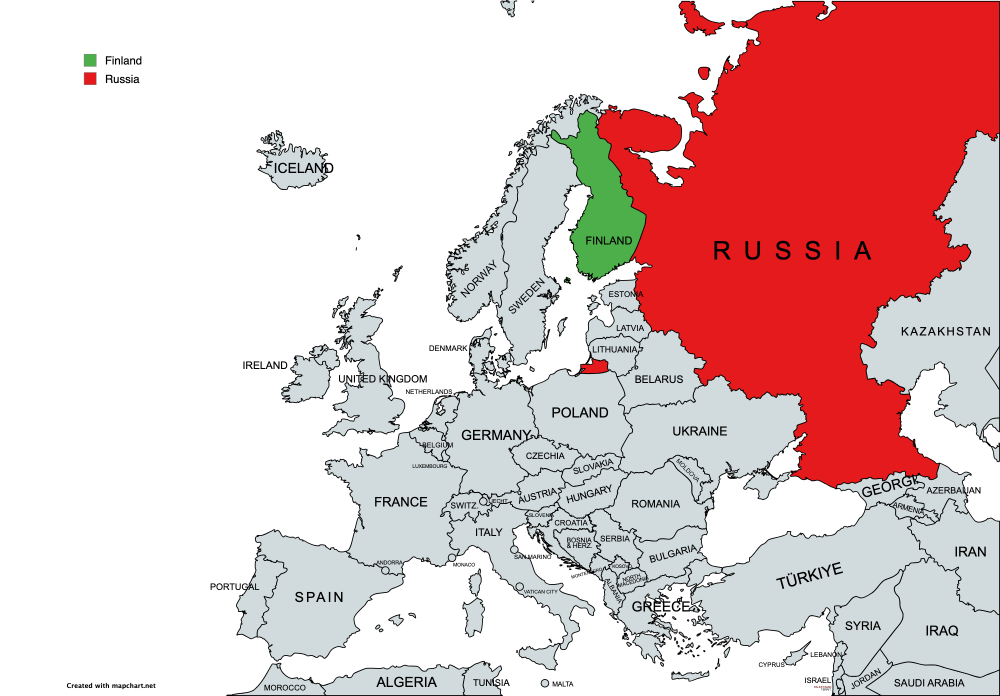
Finland = Green
Russia = Red
Image is licensed under the Creative Commons Attribution-Share Alike 4.0 International license and was created using MapChart (https://mapchart.net).