European governments are pushing back against new tariff threats announced by U.S. President Donald Trump, warning that the measures could strain alliances and disrupt trade across the Atlantic. The dispute centers on Greenland, an autonomous territory within the Kingdom of Denmark, and Trump’s renewed effort to bring the Arctic island under U.S. control.
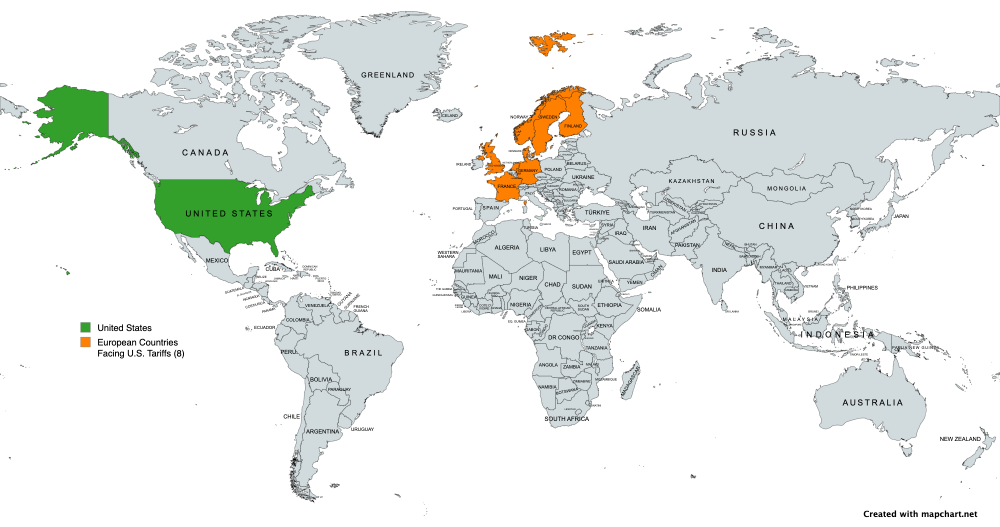
On Saturday, Trump said the United States would impose a 10% tariff on imports from Denmark, Norway, Sweden, France, Germany, the United Kingdom, the Netherlands, and Finland starting February 1. He added that the rate would rise to 25% on June 1 if negotiations over Greenland do not produce what he described as a satisfactory outcome. The president framed the tariffs as a response to recent deployments of small military units to Greenland by several European NATO members.
Those troop movements were part of a coordinated security exercise requested by Denmark and carried out with allied partners. European leaders insist the deployments are defensive in nature and are intended to reinforce stability in the Arctic at a time of growing geopolitical competition.
Greenland’s political status has been a recurring source of tension since Trump first floated the idea of purchasing the territory during his earlier term in office. Greenlandic and Danish officials have repeatedly rejected the proposal, stressing that the island’s future must be decided by its own people. Greenland already hosts a U.S. military presence under long-standing defense agreements, including the Pituffik Space Base, and Denmark has said it is open to expanding cooperation with Washington within existing frameworks.
Reaction from Europe was swift. European Commission President Ursula von der Leyen said member states would respond together, arguing that trade penalties against allies would weaken cooperation and harm economic ties on both sides. EU foreign policy chief Kaja Kallas warned that internal disputes among partners could benefit rival powers such as Russia and China.
National leaders echoed those concerns. French President Emmanuel Macron said tariff threats and political pressure would not alter France’s position on sovereignty. British Prime Minister Keir Starmer described the move as misguided, saying allies should not be punished for acting within NATO’s collective security arrangements. Sweden’s prime minister said only Denmark and Greenland have authority over decisions concerning the territory.
Denmark expressed surprise at the announcement, with officials noting that recent meetings with U.S. counterparts had been constructive. Copenhagen has increased defense spending in the Arctic and maintains that transparency and cooperation with allies remain its guiding principles.
The situation has sparked public demonstrations in Greenland, where residents gathered in the capital, Nuuk, to oppose any transfer of sovereignty. Opinion surveys indicate broad resistance among Greenlanders to joining the United States, with many emphasizing self-determination and existing ties to Denmark.
In the United States, Trump’s tariff plan has drawn criticism from lawmakers in both parties. Several senators warned that the measures could raise prices for American consumers, harm exporters, and complicate relations with long-time allies. Some have pledged to pursue legislation aimed at blocking the tariffs.
As European ambassadors prepare for emergency talks in Brussels, the dispute highlights growing strains within Western alliances. With Arctic security, trade relations, and diplomatic trust all in play, many officials are urging dialogue to prevent the standoff from deepening further.
USA = Green
European Countries Facing U.S. Tariffs(8) = Orange
Image is licensed under the Creative Commons Attribution-Share Alike 4.0 International license and was created using MapChart (https://mapchart.net).