A U.S. military strike authorized by President Donald Trump on a vessel allegedly tied to Colombia’s National Liberation Army (ELN) has drawn sharp condemnation from Bogotá, with officials claiming that at least one civilian fisherman was among those killed. The strike, carried out Friday in international waters, marks the latest in the Trump administration’s expanding campaign against drug-smuggling operations in the Caribbean.
Secretary of War Pete Hegseth announced the operation Sunday, describing it as a “lethal kinetic strike” conducted under presidential direction. According to U.S. intelligence, the targeted vessel was traveling along a well-known trafficking route and transporting large quantities of illegal narcotics.
“There were three male narco-terrorists aboard the vessel,” Hegseth wrote on X. “All three were killed, and no U.S. forces were harmed.” He said the group was linked to the ELN, which the U.S. designates as a foreign terrorist organization.
Hegseth compared Latin American drug cartels to Al Qaeda, arguing that they use terror and violence to destabilize governments and threaten American lives. He pledged that the U.S. military would continue treating such groups as enemy combatants. The Department of War released declassified video footage showing the strike obliterating the small craft at sea.
Colombian President Gustavo Petro strongly disputed Washington’s version of events, asserting that the destroyed boat was not connected to the ELN. Petro said it belonged to a family from the coastal city of Santa Marta who depended on fishing to survive. He accused the Trump administration of killing innocent civilians and demanded that it explain its actions to the victims’ relatives. The Colombian leader called the operation a violation of international law and his country’s sovereignty, claiming the vessel had sent a distress signal before being attacked.
Legal observers have questioned the legitimacy of the U.S. approach, suggesting it blurs the line between counterterrorism and law enforcement. Human rights groups say the policy of targeting alleged traffickers by military force risks setting a precedent for extrajudicial killings.
The strike adds to a growing list of U.S. operations in the region. At least seven attacks have taken place since September, killing more than 30 suspected smugglers. In one recent case, two survivors were rescued by the U.S. Navy and remain in American custody.
Tensions between Washington and Bogotá have worsened as Trump escalates his “war on cartels.” The president recently accused Petro of enabling drug trafficking and announced the suspension of all U.S. aid to Colombia. Petro responded by calling Trump “uninformed” and denying any involvement in narcotics networks.
Critics in Congress are pushing back against the administration’s expanded use of military authority. Senators Rand Paul and Tim Kaine led an effort to restrict the president’s ability to authorize lethal action without congressional approval. “We are killing people accused of crimes without trial,” Paul said, warning that the policy erodes the rule of law.
Despite mounting controversy, Hegseth said similar operations will continue as part of a broader effort to dismantle what the administration calls “narco-terrorist networks” across the Western Hemisphere.
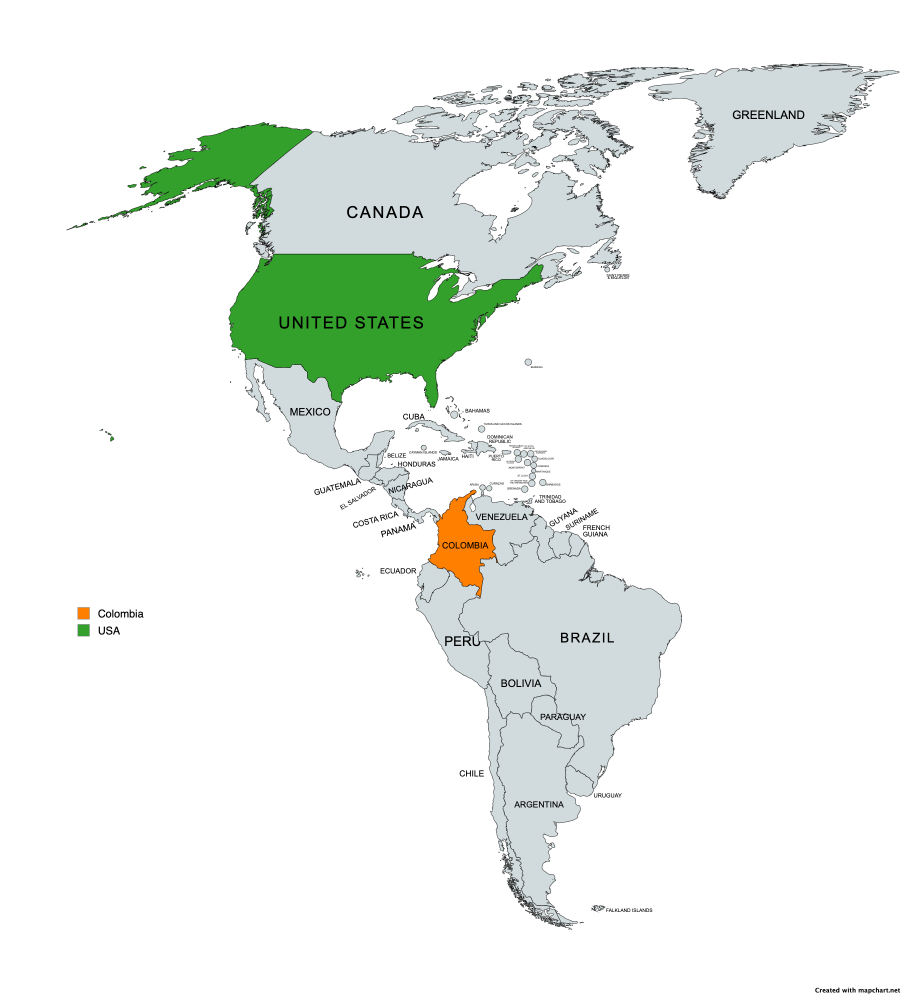
Green = USA
Colombia = Orange
Image is licensed under the Creative Commons Attribution-Share Alike 4.0 International license and was created using MapChart (https://mapchart.net).