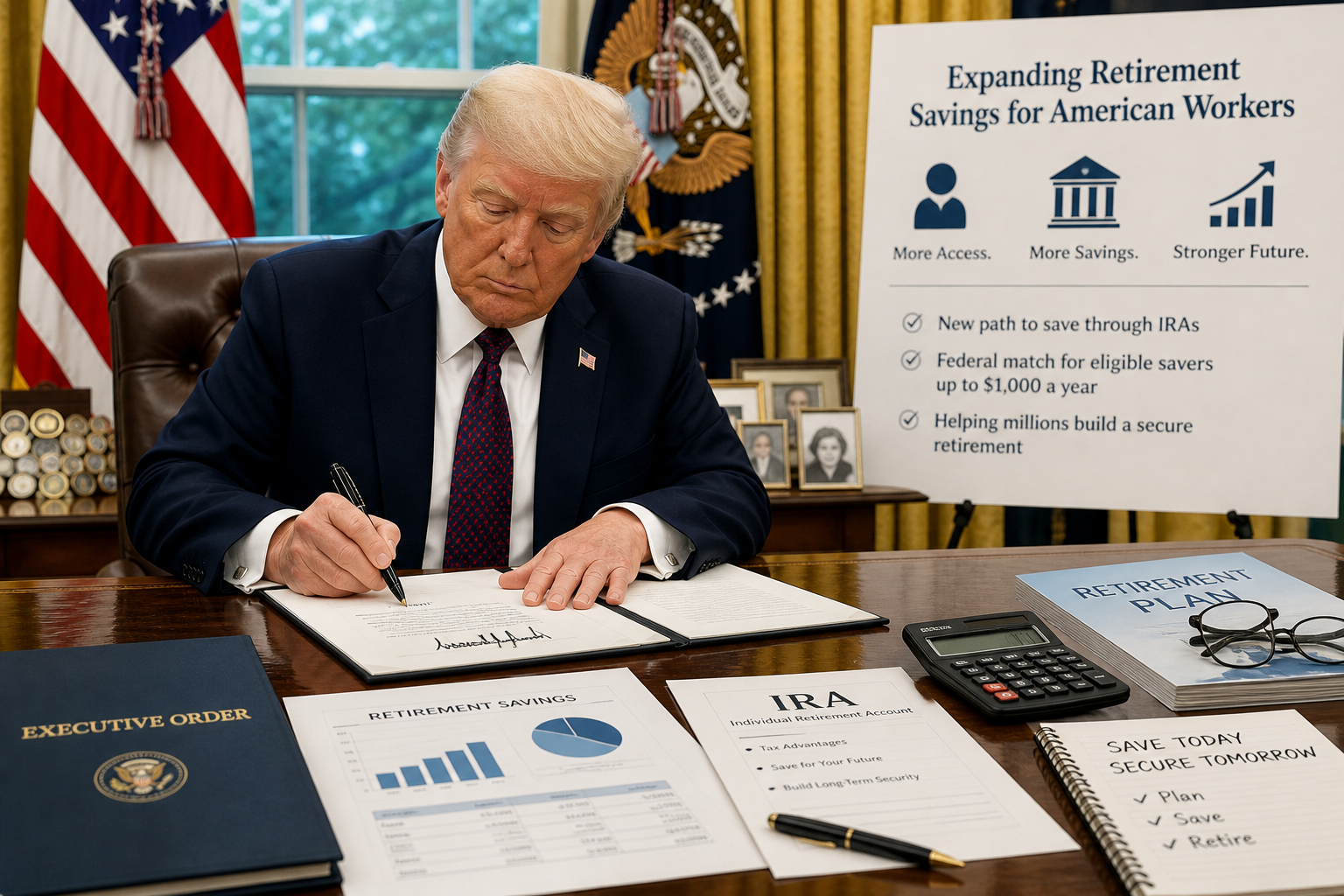
President Donald Trump signed an executive order Thursday(4/30/26) creating a new path for workers without job-based retirement plans to save through private-sector accounts, with a federal matching benefit for some lower-income earners.
The order directs the Treasury Department to launch TrumpIRA.gov on Jan. 1, 2027. The website would let people research, compare and enroll in individual retirement accounts, or IRAs. It is aimed at workers whose employers do not offer plans such as 401(k)s or pensions.
At a White House event, Trump said workers would be able to use retirement accounts similar to those available to federal employees through the Thrift Savings Plan system. He said eligible Americans could receive up to $1,000 a year in matching funds deposited into their accounts.
The new program is tied to the Saver’s Match, a benefit created in 2022 under Secure 2.0 legislation. Starting in 2027, the federal government is set to match 50% of up to $2,000 in retirement contributions for qualifying savers, for a maximum yearly match of $1,000.
Income limits were also outlined. Single taxpayers earning up to $20,500 and joint filers making up to $41,000 would qualify for the full match. Reduced matches would be available for single filers earning up to $35,500 and joint filers earning up to $71,000.
The White House said millions of workers currently lack access to retirement benefits on the job. According to 2025 research from The Pew Charitable Trusts, about 56 million Americans do not have access to an employer-sponsored retirement plan. White House figures said 40.6 million full-time workers do not participate in a retirement plan, while 48.8 million do not receive an employer match.
Officials said the order is especially meant to reach part-time workers, independent contractors, self-employed workers and employees at small businesses. Those groups often do not have traditional workplace plans. Some do, some don’t.
National Economic Council Director Kevin Hassett said the administration wants Congress to expand the benefit and make more people eligible. He said lawmakers are working on legislation this year.
Two bills already introduced in Congress could shape that effort. One is the Retirement Savings for Americans Act. It would automatically enroll eligible workers who lack workplace plans at a 3% contribution rate. It also proposes a federal contribution and matching funds for low- and moderate-income workers.
Another proposal, the Automatic IRA Act, would require employers with more than 10 workers who do not offer a plan to automatically enroll employees in IRAs. The default contribution would start at 6% and rise each year to 10%, unless workers opt out.
Investment research firm Morningstar released a study Thursday examining how expanded auto-enrollment and larger matches could affect retirement savings. Researchers estimated a base scenario with 3% automatic enrollment would bring 32.3 million new savers into the system and raise retirement wealth by 28%.
Under stronger versions of the proposals, including a larger government match and broader eligibility, Morningstar estimated total U.S. retirement wealth could rise by as much as 77%, or $1.35 trillion over 10 years.
Spencer Look, an associate director of retirement studies at Morningstar and co-author of the report, said automatic enrollment made the biggest difference. If workers have to sign up on their own, participation is usually lower. Making people opt out instead of opt in changes a lot.
This image is the property of The New Dispatch LLC and is not licenseable for external use without explicit written permission.