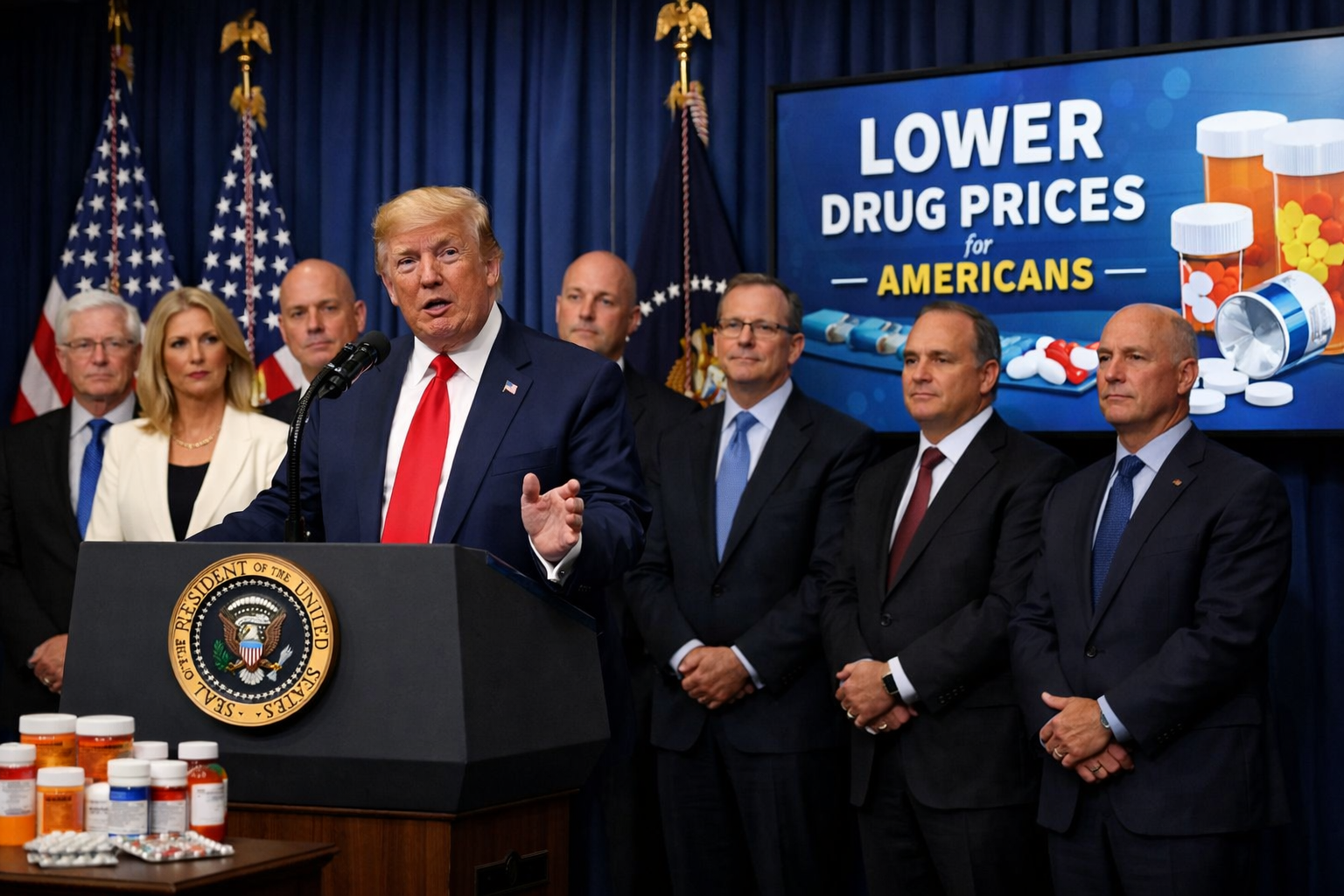
On Friday, President Donald Trump said his administration had reached new drug-pricing arrangements with a group of major pharmaceutical companies, describing the outcome as part of a broader effort to narrow the gap between U.S. prescription costs and prices paid overseas. The announcement was made during a White House press event focused on the administration’s most-favored-nation pricing agenda.
The companies named by the administration were Amgen, Bristol Myers Squibb, Boehringer Ingelheim, Genentech, Gilead Sciences, GSK, Merck, Novartis, and Sanofi. According to officials, the firms agreed to adjust pricing on selected medicines sold through state Medicaid programs so that costs more closely reflect those charged in other high-income countries. The administration also said the companies would participate in a new direct-purchase pathway intended to make certain discounted drugs available to consumers who pay out of pocket.
White House officials indicated that the pricing changes are expected to affect treatments commonly used for chronic and long-term conditions, including metabolic disorders, respiratory illnesses, infectious diseases, and some cancers. They also said participating companies committed to introducing future medicines in the U.S. market at prices that are more in line with international benchmarks, though the specifics will vary by product.
The December announcement follows earlier discussions between the administration and other pharmaceutical manufacturers earlier in the year. With the latest additions, officials said a majority of the companies initially contacted by the White House are now engaged in some form of pricing cooperation, while talks with remaining firms are continuing.
Trump, speaking during the event, repeated his long-standing criticism that Americans often pay more for prescription drugs than patients in Europe and elsewhere. He argued that voluntary agreements, combined with continued pressure on manufacturers, could gradually reduce that disparity without new legislation. Administration officials described the approach as incremental, acknowledging that changes would take time to appear in state budgets and consumer costs.
Beyond pricing, the White House said some of the companies also signaled plans to expand domestic manufacturing capacity and research operations. Officials said these commitments are intended to reduce reliance on foreign supply chains and improve preparedness for future public health emergencies. Details on the scale and timing of those investments were not fully outlined.
Reaction to the announcement varied. Supporters said even limited price adjustments could provide relief for Medicaid programs and uninsured patients, while critics questioned whether voluntary commitments would lead to lasting change. Health policy analysts also noted that Medicaid represents only a portion of overall U.S. drug spending, meaning broader impacts may be limited unless additional measures are adopted.
Administration officials said further discussions with pharmaceutical companies, insurers, and pharmacy intermediaries are planned in early 2026 as the White House continues to pursue drug pricing as a central health policy issue.
This image is the property of The New Dispatch LLC and is not licenseable for external use without explicit written permission.