Thailand launched airstrikes on Cambodian positions along their contested border on December 8, escalating the most serious confrontation between the two countries in years and threatening the fragile ceasefire brokered in October with the involvement of former U.S. President Donald Trump and regional partners.
According to Thai military officials, the Royal Thai Air Force deployed F-16 fighter jets early Monday to strike what it described as Cambodian military facilities near the Preah Vihear region, targeting suspected weapons depots, command points, and a border-adjacent casino compound that Thailand claims was being used to operate drones and store heavy weapons. The strikes followed intense fighting that erupted before dawn on December 7, when Thai units reported Cambodian fire involving small arms, machine guns, mortars, and artillery across the frontier.
Thailand said the clashes killed one Thai soldier and wounded eight more. Cambodia reported at least four civilian deaths and several injuries, accusing Thailand of “brutal and disproportionate” attacks while insisting that Cambodian troops did not initiate the violence. Both governments have blamed the other for firing first, continuing a pattern seen in previous flare-ups along the border. Cambodian Defense Ministry spokespeople said Thai forces struck positions near the UNESCO-listed Preah Vihear Temple, a focal point of past disputes, and alleged that rockets hit civilian areas. Thailand countered that Cambodian units had repositioned heavy weapons and advanced toward Thai territory at around 3 a.m., prompting what it called a “necessary suppressive operation.”
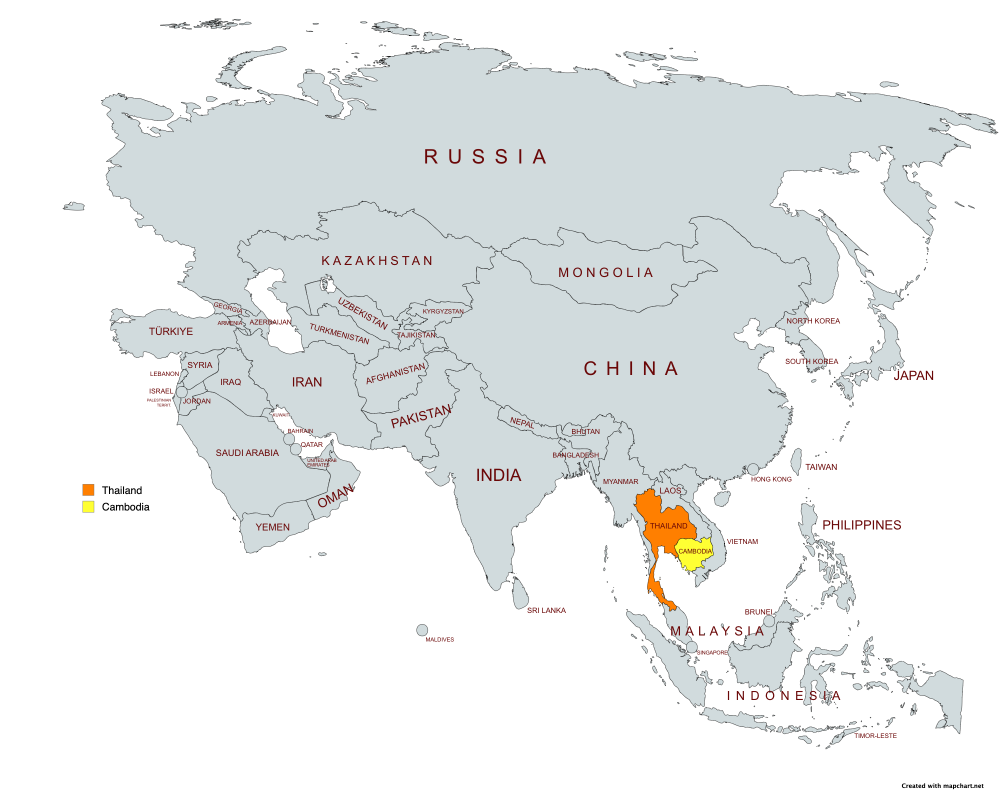
The border, stretching more than 800 kilometers and first formally mapped by French colonial authorities in 1907, has long been a flashpoint between the neighbors. Although the International Court of Justice ruled in 1962 that Preah Vihear belongs to Cambodia, nationalist sentiment and ambiguous map interpretations have fueled recurring military standoffs since the 1950s.
The fighting threatens to unravel the October 2025 ceasefire, negotiated with Trump’s involvement and facilitated by Malaysia and China, which ended a burst of violence earlier in the year that left dozens dead. That earlier conflict, triggered by a landmine incident in May, saw artillery exchanges and Thai air operations involving both F-16s and Gripen jets. Despite the truce, tensions remained high. Thailand had already suspended parts of the agreement in November following another fatal incident involving a Thai soldier.
Former Cambodian Prime Minister Hun Sen, father of current leader Hun Manet, accused Thailand of provoking clashes that could derail the fragile peace, urging Cambodian troops and civilians to remain calm.
The renewed fighting has displaced large populations on both sides. Thai authorities in Surin, Ubon Ratchathani, and other border provinces evacuated communities and moved vulnerable patients from hospitals as shelling intensified, though major medical facilities remained operational. Cambodia reported the relocation of more than a thousand families from frontline villages.
Footage circulating on social media showed smoke rising near a casino complex close to the border following Thai airstrikes, reflecting Thailand’s stated concerns over drone activity originating from sites in Cambodian frontier zones known for illicit operations.
Regional governments moved quickly to urge restraint. ASEAN called for immediate dialogue and respect for existing ceasefire commitments. Trump, who had celebrated the October truce as proof of renewed American influence in the region, criticized the breakdown of the agreement but issued no formal threats or policy steps.
As of midday December 8, exchanges of fire continued along parts of the border, with no indication of a new ceasefire being reached. Analysts warn that the confrontation, occurring amid broader strategic competition in Southeast Asia, risks drawing in regional powers and testing ASEAN unity.
The latest escalation underscores how historic disputes, contested maps, and modern military capabilities continue to shape one of Southeast Asia’s most volatile flashpoints—where the human cost is once again rising.
Orange = Thailand
Yellow = Cambodia
Image is licensed under the Creative Commons Attribution-Share Alike 4.0 International license and was created using MapChart (https://mapchart.net).