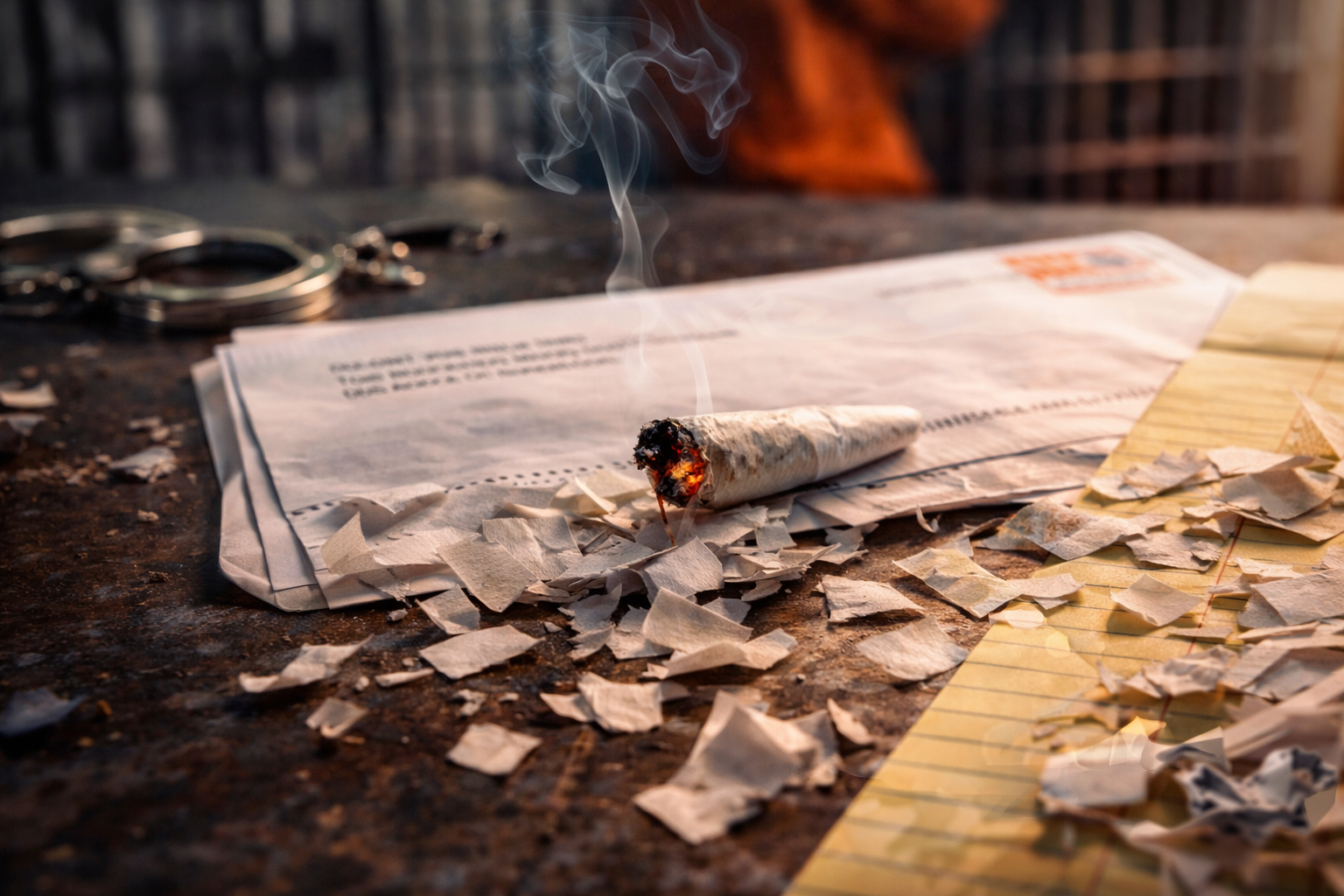
A growing form of contraband in U.S. prisons and jails involves ordinary paper that has been sprayed or soaked with powerful drugs. In correctional settings, these pieces are often referred to as “strips,” and in some jurisdictions they are also known by names such as “tune” or “paper dope.” The paper can be disguised as letters, legal-looking documents, greeting cards, photographs, or book pages.
Once inside a facility, the paper may be torn into small pieces and smoked or consumed. A 2024 case series published in JAMA Network Open examining intoxications linked to these strips at an Atlanta-area jail found that they primarily contained synthetic cannabinoids, nitazene opioids, and other novel psychoactive substances. The study documented 18 patients with suspected strip exposure between August 2022 and November 2023; one patient died, and others experienced severe symptoms including central nervous system depression, bradycardia, agitation, seizures, and hypoxia.
Correctional officials and researchers report that drug-soaked paper is difficult to detect. Research funded by the National Institute of Justice has noted that drugs embedded in or applied to paper substrates can evade routine inspection, particularly when present in very small quantities. At the same time, some agencies report success using trained drug-detection dogs and newer mail-screening methods, making detection challenging but not impossible.
The issue is not limited to the United States. Reporting and monitoring in the United Kingdom and Europe show that synthetic cannabinoids and other new psychoactive substances became a major prison concern in the mid-2010s. By 2018, European forensic researchers were documenting paper materials impregnated with synthetic drugs in correctional settings. In the United States, documented cases and policy responses have expanded in the 2020s, although precise nationwide figures remain difficult to verify. A 2025 Ohio news report, citing state officials, said more than 16,000 pieces of drug-laced paper had been confiscated in recent years.
The rise of drug-soaked paper has prompted significant policy changes. Ohio moved to digitize most incoming personal mail in 2021 to reduce the flow of drug-laced paper into facilities. Oregon tightened its incoming-mail rules in 2025, citing concerns about dangerous substances embedded in paper or ink. Illinois and New York have expanded mail-scanning practices, including for certain types of legal mail in some contexts, while Kansas cited drug-soaked paper when changing its newspaper-subscription policies. Arkansas approved a restrictive publications policy in late 2025 that limits inmates’ ability to receive books, magazines, and newspapers directly.
These changes have intensified debates over attorney-client privilege, access to information, and the broader balance between institutional security and the rights of incarcerated people. As correctional systems continue adapting to evolving smuggling methods, drug-soaked paper remains a significant and complex challenge for both public health and facility operations.
This image is the property of The New Dispatch LLC and is not licenseable for external use without explicit written permission.