European governments are increasingly moving to limit how children and teens engage with social media, with recent proposals from Spain and Greece illustrating the trend. Lawmakers and officials in several nations have expressed alarm over the possible impact of popular platforms on young people’s wellbeing and development, pushing the issue to the forefront of policy discussions.
In Spain, Prime Minister Pedro Sánchez outlined plans to bar users under 16 from accessing social media services. Speaking at the World Governments Summit in Dubai, Sánchez described digital spaces as environments where minors are often exposed to harmful material without adequate protection. He called for stronger legal protections and argued that voluntary measures by technology companies have failed to safeguard young users.
Under the Spanish proposal, companies that host social media would have to put in place age checks that go beyond simple user declarations. Sánchez also said his government intends to hold platform executives directly responsible if they fail to remove illegal or harmful content. Additional elements of the plan would turn certain forms of algorithm based amplification of unlawful material into offenses with legal consequences.
Officials in Greece are preparing similar rules. A senior government source said Athens is considering restricting social media access for children under 15. Although the details have not been fully released, Greek leaders say the aim is to address growing concerns about how screen time and online exposure affect children’s safety and behavior.
The announcements have drawn attention beyond European capitals. Elon Musk, owner of the social network X, criticized Sánchez on the platform, calling his proposals extreme and framing them as a challenge to free speech. The exchange highlighted broader disagreements between political leaders seeking more controls and technology figures who view such steps as overreach.
Spain and Greece are part of a wider movement in which countries are weighing different types of age based limits. In Australia, lawmakers adopted a law last year that blocks social media access for children under 16, forcing major platforms to build systems that more reliably verify users’ ages or face fines. That approach has been closely watched by regulators in other regions.
In France, lawmakers have approved a measure that would bar children under 15 from social media, with a goal of having the new requirement in force before schools reopen in late 2026. Denmark has introduced its own legislative proposal to restrict access for those under 15, and debates continue in the United Kingdom about whether to introduce a prohibition for users under 16.
Some technology companies have pushed back against broad age based restrictions. Industry representatives argue that determined young people will find ways to access online spaces through alternative channels, potentially weakening safeguards. Others contend that excluding children from major platforms could cut them off from supportive online communities and social interactions. Meta, for example, has said it deactivated large numbers of accounts believed to belong to minors in Australia, but has urged governments to work more collaboratively with industry when crafting policy.
Sánchez has said Spain is working with a group of other European governments on cross border measures, acknowledging that social media platforms operate internationally while laws tend to be national. He described the partnership as a way to share enforcement ideas and align regulatory efforts.
In Spain, the new proposals must still be approved by Parliament, a process that could prove challenging given the current makeup of Sánchez’s governing coalition. While some opposition parties have expressed support for stronger protections, others have raised questions about how the rules would be enforced and whether they could create unintended consequences.
As these debates unfold, the issue of youth engagement with social media continues to draw both political energy and public scrutiny. Governments around the world are reassessing how best to protect children online while balancing the benefits and risks of digital connection.
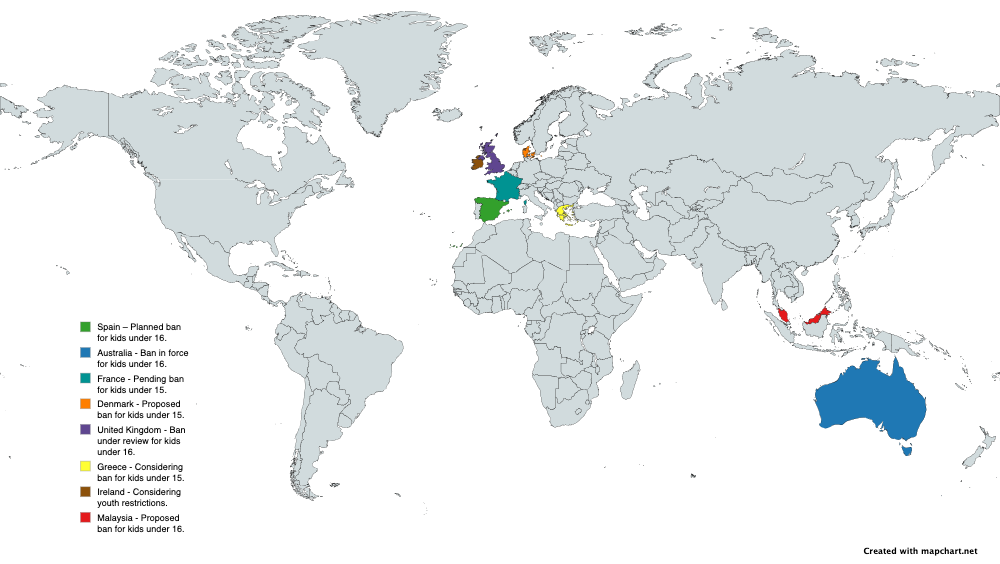
That reassessment is already translating into policy in several countries, each tailoring restrictions to its own legislative and cultural context. Some of the key nations pursuing social media limits for minors include:
Spain (Upcoming): Plans to ban social media access for users under 16, with requirements for reliable age verification. New laws are expected to come into effect in early February 2026 once approved by Parliament.
Australia (Implemented): In December 2025, Australia became the first nation to put such a ban into practice, forbidding children under 16 from major platforms including TikTok Instagram and Facebook and requiring age checks or fines for non compliance.
France (Pending): Lawmakers have passed rules that would block social media use for those under 15, with implementation targeted before the school year begins in September 2026.
Denmark (Proposed): Danish officials have introduced legislation that would restrict platform access for users under 15 as part of a broader digital safety agenda.
United Kingdom (Considering): The British government is reviewing proposals that could lead to a ban on social networks for under 16s following parliamentary consultations.
Greece & Ireland (Expressing Intent): Both countries have signaled interest in following this regulatory route by introducing similar limits for younger users.
Malaysia (Proposed): Malaysian authorities plan to prohibit children under 16 from maintaining open social media accounts, with new regulations expected to begin in 2026.
Taken together, these efforts reflect a growing willingness among governments to redefine how children interact with social technology and to test new tools for managing the risks associated with digital environments.
Spain (Planned ban for kids under 16) = Green
Australia (Ban in force for kids under 16) = Blue
France (Pending ban for kids under 15) = Teal
Denmark (Proposed ban for kids under 15) = Orange
United Kingdom (Ban under review for kids under 16) = Purple
Greece (Considering ban for kids under 15) = Yellow
Ireland (Considering youth restrictions) = Brown
Malaysia (Proposed ban for kids under 16) = Red
Image is licensed under the Creative Commons Attribution-Share Alike 4.0 International license and was created using MapChart (https://mapchart.net).