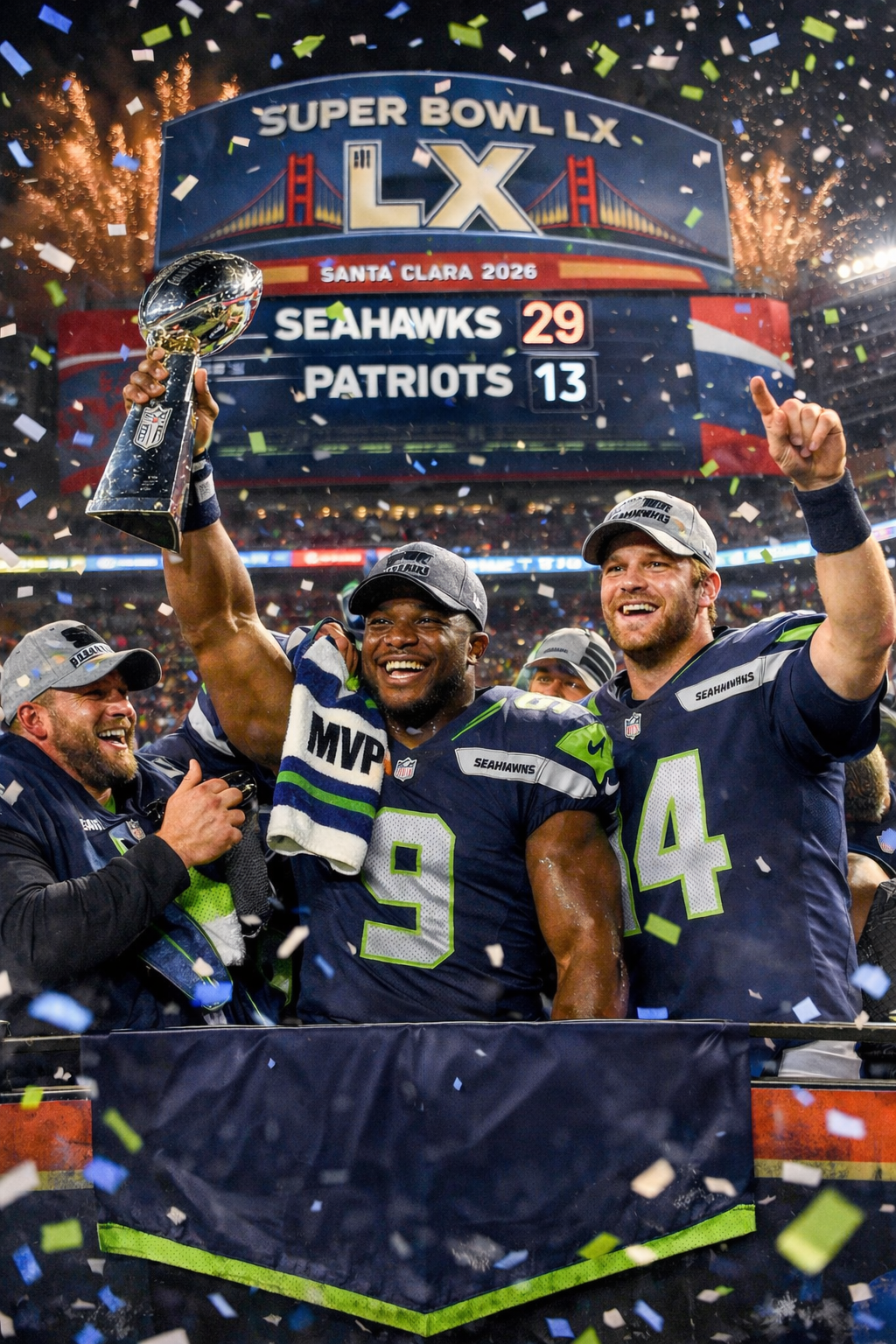
The Seattle Seahawks added a second championship to the franchise record on February 8, 2026, defeating the New England Patriots 29–13 in Super Bowl LX. The game took place in Santa Clara, California, in the San Francisco Bay Area, and unfolded as a methodical, defense-first contest that gradually tilted in Seattle’s favor before the team created distance in the final quarter.
For much of the evening, neither offense found much room to operate. Seattle established control early through field position, defense, and special teams, relying on steady execution rather than explosive plays. Kicker Jason Myers played a central role in building the lead, converting five field goals over the course of the game — the most ever made by a player in a Super Bowl. Those consistent points allowed the Seahawks to stay in front even while both teams struggled to reach the end zone.
The defensive tone defined the first three quarters. Seattle’s front applied regular pressure and limited big plays, while the secondary kept the Patriots from finding rhythm downfield. New England had difficulty sustaining drives, and each stalled possession helped Seattle maintain control of the tempo. The Seahawks’ offense responded by emphasizing ball security, clock management, and a balanced attack designed to avoid costly mistakes.
The game’s momentum shifted decisively in the fourth quarter. After building an advantage through Myers’ field goals and steady defensive stops, Seattle broke through with touchdowns that widened the gap and put the outcome firmly in hand. New England managed to answer with two late scores, trimming the margin, but the result was never seriously in doubt as the final minutes ticked away.
Running back Kenneth Walker III delivered the most influential performance of the night and was named Super Bowl MVP. His work on the ground helped Seattle control the pace and wear down the defense, particularly during key stretches when maintaining possession was critical. Walker’s ability to gain tough yards kept drives alive and allowed Seattle to dictate the flow of the game.
Quarterback Sam Darnold directed the offense with composure and efficiency. While the passing attack was not built around big numbers, it proved effective when needed. He avoided major errors, made timely throws in key situations, and helped sustain possessions that led to points. His steady presence complemented the team’s overall approach, which centered on patience and discipline.
The victory marked Seattle’s first championship since the 2013 season and represented a major step forward under head coach Mike Macdonald in his second year leading the team. Throughout the postseason, the Seahawks developed an identity built on physical defense, consistent special teams play, and a dependable rushing attack. That formula carried through on the league’s biggest stage.
Super Bowl LX was broadcast nationally on NBC and featured a halftime performance headlined by Bad Bunny, adding to the event’s atmosphere as millions watched from across the country.
As the clock wound down and the celebration began, the significance of the moment was clear. Seattle had relied on preparation, balance, and resilience to navigate a tightly contested matchup and emerge on top. By combining record-setting special teams production, a strong defensive effort, and an efficient offensive plan, the Seahawks secured another title and reinforced their place among the NFL’s most successful franchises of the era.
This image is the property of The New Dispatch LLC and is not licenseable for external use without explicit written permission.