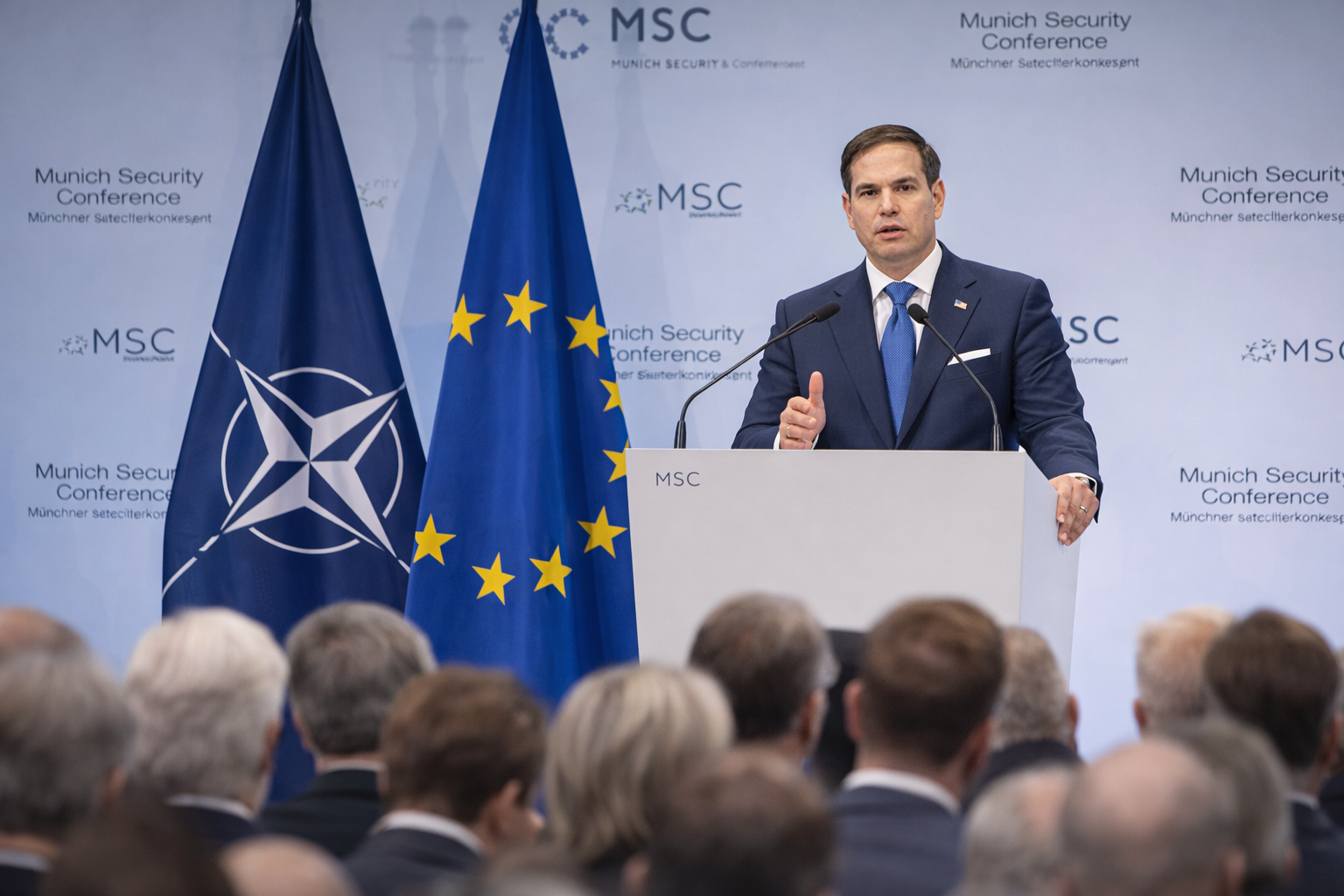
At the Munich Security Conference, U.S. Secretary of State Marco Rubio delivered a message aimed at reassuring European leaders that Washington remains committed to its partnership with the continent. Speaking to an audience of diplomats, policymakers, and military officials, Rubio emphasized that the United States does not intend to step away from the transatlantic alliance. Instead, he said the relationship between the U.S. and Europe remains deeply rooted in shared values, culture, and interests, and that both sides should work together to strengthen it in the years ahead.
Rubio described the United States as forever linked to Europe by heritage and common purpose, stressing that cooperation would remain central to American foreign policy. He told attendees that the goal was not to drift apart but to renew and strengthen ties that have shaped global affairs for decades. His tone contrasted with last year’s conference, when Vice President JD Vance delivered a speech that many European leaders perceived as confrontational. Rubio’s address, while containing criticism, focused more on unity and long-term partnership.
European Commission President Ursula von der Leyen responded warmly to Rubio’s remarks, saying she felt reassured by his commitment to maintaining strong relations. She echoed his view that a strong Europe working alongside a strong United States benefits both sides. Other European leaders also signaled that they see the relationship as vital, especially as tensions continue in Eastern Europe and concerns about global security remain high.
Despite the cooperative message, Rubio did not shy away from pointing out areas where Washington believes Europe should change course. He raised concerns about immigration policies, warning that mass migration could create social and political instability. He also criticized what he described as excessive focus on climate policies that he believes are harming economic growth. On trade, he said both sides had embraced overly rigid ideas about free markets in the past and should rethink some of those approaches.
Defense spending was another key point in his speech. Rubio called on European nations to invest more in their own military capabilities, arguing that stronger European forces would make the entire alliance more secure. He said the United States wants partners who can protect themselves and contribute to collective strength, reducing the risk that adversaries might test the unity of Western nations.
The conference also featured discussion of the ongoing war in Ukraine. Rubio acknowledged uncertainty about Russia’s willingness to end the conflict, saying Washington would continue to test whether a peaceful resolution was possible. Ukrainian President Volodymyr Zelensky, who also addressed the gathering, warned that his country remains under constant threat and said there is little trust that Russia would halt its aggression. He rejected the idea of holding elections while martial law remains in place, saying a ceasefire and improved security would be necessary first.
European leaders used the event to stress the need for greater self-reliance in defense and closer coordination within NATO. French President Emmanuel Macron and British Prime Minister Keir Starmer both called for Europe to strengthen its military readiness and reduce reliance on outside support. German Chancellor Friedrich Merz acknowledged tensions between Europe and the United States but appealed for renewed trust and cooperation.
Overall, the conference reflected a shared desire to maintain strong ties despite disagreements. Rubio’s speech signaled that, even amid policy differences, the United States still sees its relationship with Europe as a cornerstone of its global outlook.
This image is the property of The New Dispatch LLC and is not licenseable for external use without explicit written permission.