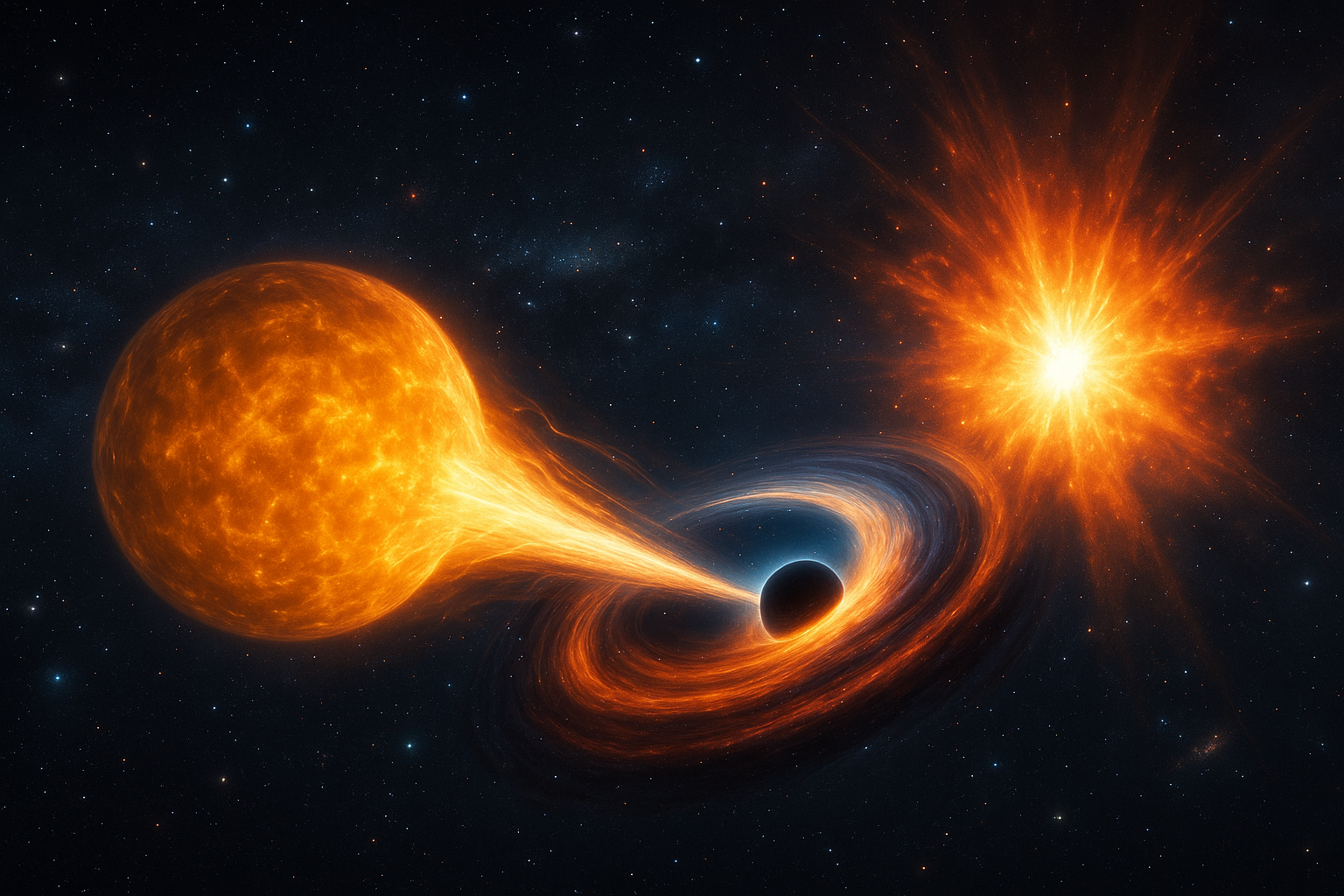
Astronomers have identified an unusual cosmic event in which a black hole appears to have played a central role in triggering the destruction of a massive star. The explosion, cataloged as SN 2023zkd, was first observed in July 2023 by the Zwicky Transient Facility and has since been analyzed by researchers at the Center for Astrophysics and collaborating institutions.
Archival observations revealed that the star system had been gradually increasing in brightness for more than four years before the supernova occurred, a highly uncommon pattern. This prolonged brightening suggests the dying star may have been interacting closely with a companion object well before the final blast.
Scientists believe two explanations are possible. The first is that the black hole’s gravitational influence stripped away the star’s outer layers, creating instability that ultimately led to the explosion. The second is that the black hole completely tore the star apart before it could undergo a natural supernova process, making the black hole’s role decisive in the star’s demise.
SN 2023zkd stands out because of the clarity of its pre-explosion signals, offering one of the most detailed looks yet at how a massive star might interact with a nearby black hole. Researchers say this makes it a valuable case study for understanding both stellar evolution and the dynamics of extreme binary systems.
A key element in the discovery was the use of real-time anomaly detection powered by artificial intelligence. The system flagged the unusual activity in the observational data, enabling astronomers to prioritize follow-up studies. This same AI framework, scientists say, could be applied in future surveys to catch other rare or unusual astronomical events as they unfold.
The findings could also inform models of how stars and black holes exchange matter and energy over long periods. By examining the light curve and other emission data from SN 2023zkd, researchers hope to refine predictions for how similar systems behave in their final stages.
While questions remain about exactly how the black hole triggered the event, the combination of long-term monitoring, archival data analysis, and AI-driven detection provided a rare glimpse into a stellar death in progress. Such insights may help scientists spot similar interactions earlier and study them in greater detail before the final explosion.
This image is the property of The New Dispatch LLC and is not licenseable for external use without explicit written permission.