On February 5, 2026, the New Strategic Arms Reduction Treaty, widely known as New START, officially expired, leaving the United States and Russia without any active limits on their strategic nuclear arsenals for the first time in more than half a century. The agreement, originally signed in 2010, placed caps on the number of deployed nuclear warheads and delivery systems each country could maintain. Its end has raised concern among lawmakers, military analysts, and international leaders who fear a renewed period of nuclear competition between the world’s two largest atomic powers.
New START limited both nations to 1,550 deployed strategic warheads and 700 deployed launchers, including intercontinental ballistic missiles, bombers, and submarine-based systems. The treaty also required regular data exchanges and short-notice inspections. These measures helped maintain transparency and predictability, allowing each country to monitor the other’s capabilities and reduce the risk of miscalculation. Over its lifetime, the agreement facilitated tens of thousands of notifications related to nuclear movements and deployments, fostering a level of trust even during periods of political tension.
With the treaty now expired as of February 5, 2026, those guardrails are gone. Lawmakers in Washington have voiced concern that the absence of formal limits could fuel an arms race. Senator Ed Markey warned that the collapse of the agreement could remove the last barrier preventing the United States and Russia from expanding their nuclear stockpiles. Representative John Garamendi echoed that concern, pointing to the risk of accidents or misunderstandings that could arise as arsenals grow and communication declines.
Former President Barack Obama, who signed the treaty with Russian President Dmitry Medvedev, urged Congress to take action to preserve the decades of diplomacy that reduced nuclear risks. Since the early 1970s, Washington and Moscow have maintained some form of arms control framework, gradually cutting down stockpiles that once reached tens of thousands of warheads during the Cold War. Earlier agreements, including the original START treaty in 1991 and the Treaty of Moscow in 2002, played a role in lowering the number of active weapons and building confidence between the two nations.
The current political climate has complicated efforts to negotiate a successor agreement. Russia suspended its participation in New START in 2023 amid tensions related to the war in Ukraine and stopped sharing required data. More recently, Moscow offered to continue observing the treaty’s limits informally for another year to allow time for negotiations, but the United States has not formally accepted the proposal.
President Donald Trump has sent mixed signals on the future of nuclear arms control. At times, he has expressed interest in creating a new agreement and has suggested that China should be included in future talks. At other moments, he has dismissed concerns about the treaty’s expiration and indicated the United States might resume nuclear testing alongside Russia and China. The White House has said the president will clarify his strategy on his own timeline.
Some Republican leaders argue the treaty no longer reflects modern security challenges. Senator Roger Wicker described it as a product of a different era and pointed to growing threats from China and North Korea. He suggested that strengthening the U.S. nuclear arsenal and developing new defensive systems may be more effective than pursuing another treaty.
Arms control advocates disagree, saying limits on nuclear weapons are in the direct interest of U.S. security. They warn that increasing the number of weapons raises the chances of errors, theft, or unintended conflict. Experts also note that building new nuclear forces would be extremely costly, at a time when the United States is already planning major upgrades to its existing arsenal.
While few analysts expect an immediate surge in weapons production, the absence of formal agreements means both nations may plan for worst-case scenarios. Without inspections, shared data, or negotiated limits, uncertainty could grow. As global tensions remain high and China expands its own nuclear capabilities, the future of arms control remains unclear, leaving many to question whether diplomacy can once again place limits on the world’s most powerful weapons.
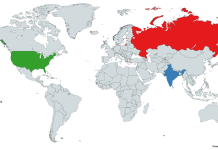
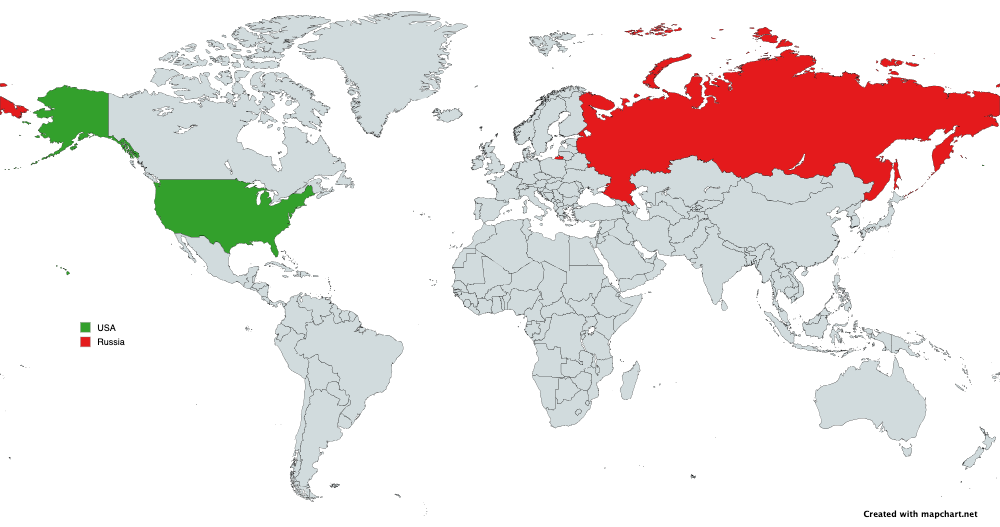
USA = Green
Russia = Red
Image is licensed under the Creative Commons Attribution-Share Alike 4.0 International license and was created using MapChart (https://mapchart.net).