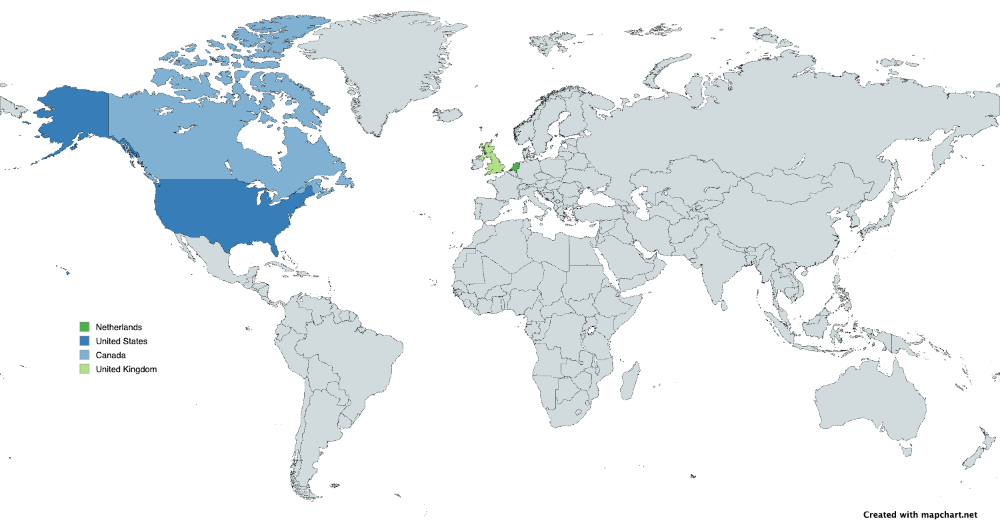
The Netherlands has changed where it keeps a large part of its national gold supply, moving billions of dollars in reserves away from the United States and Canada. More Dutch gold is now stored in London, which the country’s central bank says gives it quicker access to the metal if a serious financial crisis occurs.
The Dutch Central Bank, known as DNB, carried out the operation over several months. The change did not involve bringing all of the country’s overseas gold home. Instead, the bank rearranged its holdings so they are spread more evenly between the Netherlands, Britain and North America.
The country has 612.4 tonnes of gold reserves. At the end of 2025, those holdings were valued at around 72.2 billion euros, or about $83.8 billion.
Before the relocation, New York contained the biggest overseas portion. About 31.3 percent of the Dutch supply was there, compared with 19.7 percent in Ottawa and 18.1 percent in London. Another 30.8 percent was kept at a Dutch storage facility in Zeist.
Now the picture is different. London holds 32.1 percent, making it the largest individual location for Dutch reserves. Zeist remains unchanged at 30.8 percent. New York and Ottawa each have 18.5 percent.
Moving that much gold was not simply a matter of loading bars onto planes or ships.
DNB used two separate methods. It sold roughly 59 tonnes from its New York holdings and purchased an equivalent amount in London. The bank also physically brought more than 27 tonnes from North America to Zeist. Around the same amount was sent from Zeist to London using bars that already met the standards required for international trading.
This approach reduced the amount of physical transportation needed. It also gave DNB experience with two different ways of relocating reserves, something the bank believes could be useful if another emergency made one method difficult to carry out.
The reason for putting more gold in Britain mostly comes down to access. London has a large international market for the metal, and gold kept there can be converted or put to use faster during a financial emergency. DNB said reserves sitting in New York and Ottawa are less immediately available for that purpose.
The relocation comes while international relations have been unsettled by wars, tariffs and disagreements between governments. The United States and Canada have been involved in a trade dispute, while relations between Washington and several European governments have also become more strained. DNB has not said that any one of those disputes caused its decision.
The bank instead described the change as preparation for situations where ordinary financial systems may not work as expected. Gold can act as a reserve that remains available during those kinds of disruptions.
This is also not the first time Dutch officials have reduced the amount stored in the United States. In 2014, the Netherlands brought some of its New York holdings back home as part of an earlier change in how the reserves were divided.
France and Germany have made their own changes to overseas gold holdings over the years. France moved gold from New York back to Paris earlier this year, while Germany transferred hundreds of tonnes from New York to Frankfurt between 2013 and 2017.
Details of the latest Dutch operation were kept out of public view while the transfers were happening. Officials disclosed the plan only after the work was finished because of the security concerns involved in moving national gold reserves.
Netherlands = Green
UK = Light Green
USA = Blue
Canada = Light Blue
Image is licensed under the Creative Commons Attribution-Share Alike 4.0 International license and was created using MapChart (https://mapchart.net).