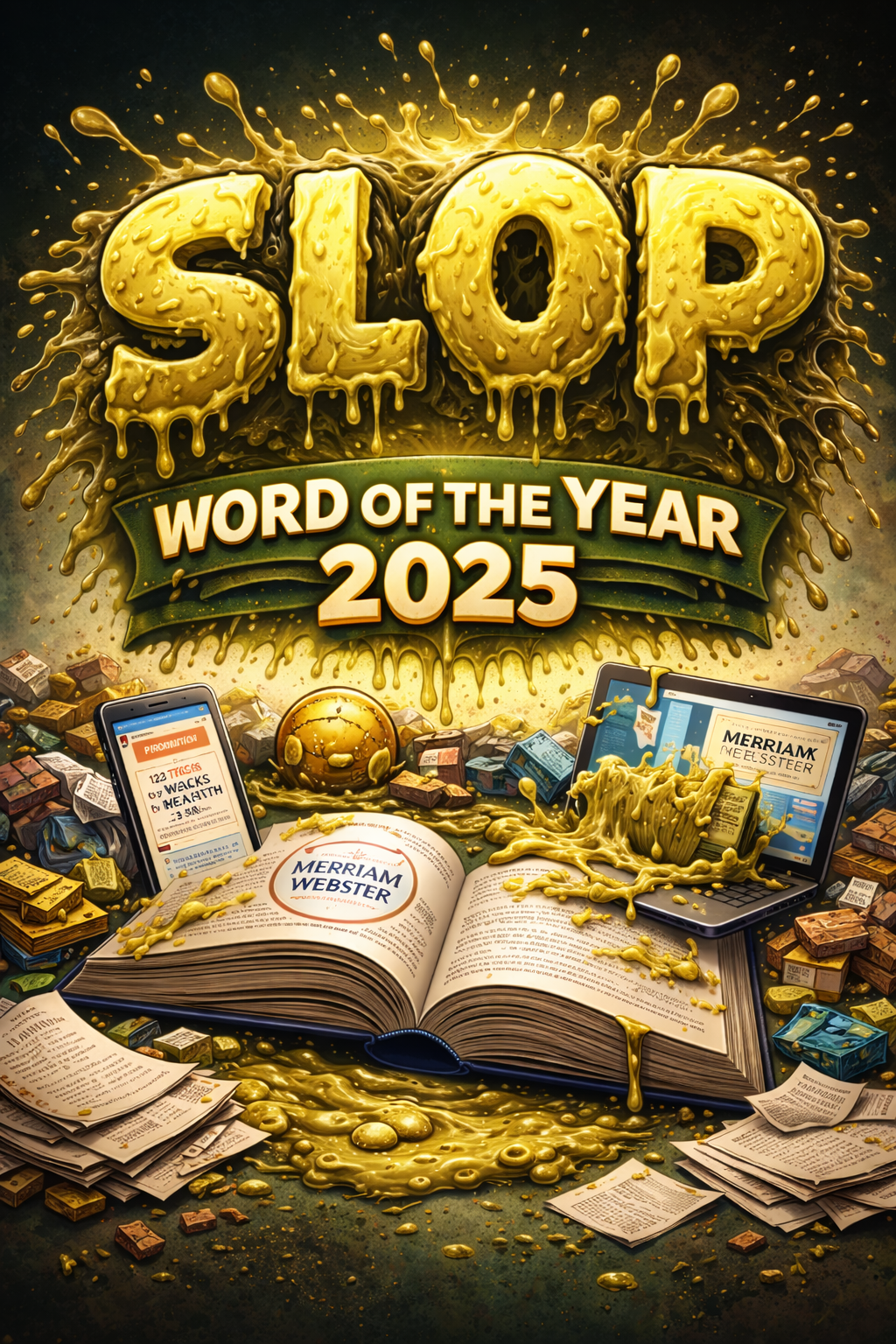
Merriam-Webster, the U.S. dictionary publisher, has named “slop” its Word of the Year for 2025, citing rising public frustration with the spread of low-quality material generated by artificial intelligence. The announcement was made on December 15, following a year in which interest in the term increased sharply.
In its updated usage, the word is commonly used to describe mass-produced digital material that many users regard as crude, disposable, or lacking substance, often created with automated tools rather than by human authors. Editors at Merriam-Webster said searches for the term rose as people encountered more AI-generated text, images, and videos across social platforms, search results, and online marketplaces.
The expression appeared frequently in discussions about misleading visuals, spam-like posts, promotional content, and hastily assembled books. It is often used critically or ironically, reflecting dissatisfaction with both the volume and quality of online material.
Although the term has gained renewed attention in a digital context, it has been part of the English language for centuries. Earlier meanings referred to mud, waste, or unappetizing food, associations that continue to shape how the word is understood today.
Merriam-Webster has selected a Word of the Year annually since 2003, basing the choice on a combination of search activity and cultural relevance. Recent selections have reflected shifts in public discourse, including “polarization” in 2024 and “authentic” in 2023.
Alongside “slop,” the publisher reported increased interest in several other terms during 2025, many tied to online behavior, media consumption, and civic life. Editors said these trends point to a year shaped by questions about trust, quality, and the effects of rapidly evolving technology.
As artificial intelligence tools become more widely used, the choice of “slop” reflects a broader moment of scrutiny over how digital content is created and consumed. The word’s selection highlights concerns not only about poor-quality material, but also about the changing nature of the information environment itself.
This image is the property of The New Dispatch LLC and is not licenseable for external use without explicit written permission.