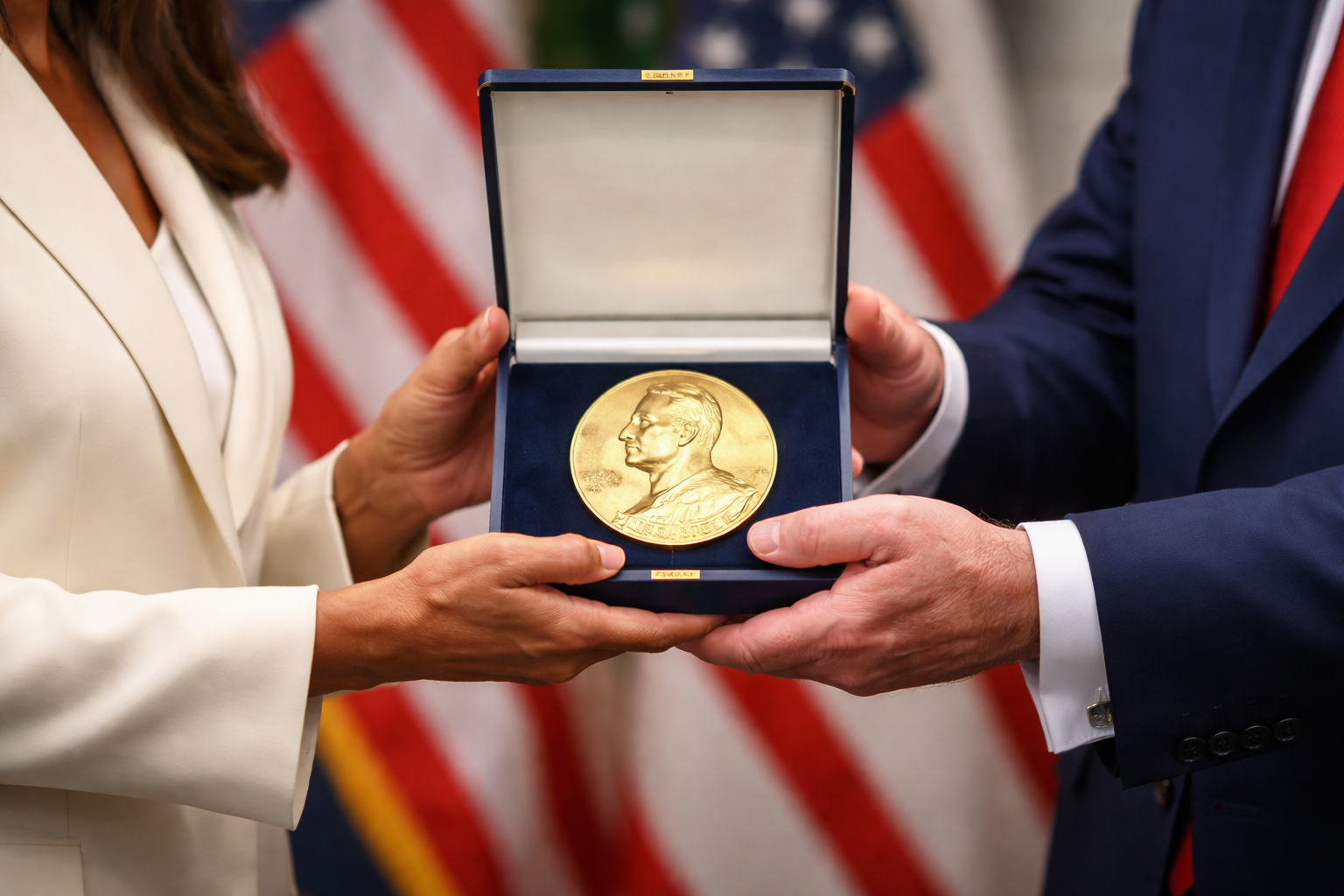
María Corina Machado’s recent visit to Washington unfolded at a moment of uncertainty for Venezuela, with power arrangements in flux and international actors weighing their influence. Her decision to hand her Nobel Peace Prize medal to U.S. President Donald Trump during a White House meeting became the focal point of the trip, drawing praise from some allies, criticism from others, and renewed debate about symbolism versus substance in international politics.
Machado framed the gesture as an expression of appreciation for U.S. support, particularly following the American operation that led to the capture of Nicolás Maduro earlier this month. Trump accepted the medal, later calling the exchange a gesture of respect and thanking Machado publicly. The White House reinforced that message by releasing photographs of the president holding a framed display containing the medal, alongside language crediting his role in promoting peace and stability.
The meeting itself was relatively brief, but its implications extended well beyond the Oval Office. Machado has been seeking to secure backing from Washington as Venezuela navigates an uncertain transition. While she remains a leading opposition voice, Trump has made clear that he doubts her ability to govern in the near term, arguing that she does not currently command broad domestic support. That position has placed Machado in competition with figures inside Venezuela’s interim leadership, particularly President Delcy Rodríguez, whom Trump has described as pragmatic and cooperative.
After leaving the White House, Machado met with lawmakers on Capitol Hill, where she encountered a more receptive audience. Several senators said she warned that political pressure, arrests, and restrictions remain in place despite recent prisoner releases announced by Caracas. Senator Chris Murphy said Machado conveyed concerns that the current leadership is consolidating control rather than preparing for open elections, leaving the path forward unclear.
International reaction was swift, especially in Norway, home of the Nobel Peace Prize. Politicians and commentators there criticized Machado’s action as inappropriate and potentially damaging to the reputation of the award. Others responded by stressing that the Nobel title remains attached solely to the person selected by the committee. Both the Norwegian Nobel Institute and the Nobel Peace Center reiterated that while the medal itself can change hands, the prize cannot be reassigned, shared, or withdrawn.
Machado has defended her decision by casting it as symbolic rather than transactional. She has pointed to historical examples of leaders exchanging medals as signs of shared purpose, arguing that her action was meant to reflect solidarity between Venezuelans and Americans in opposition to authoritarian rule. She has also emphasized that the Nobel recognition represents the struggle of Venezuelan society as a whole, not her individual standing.
Trump, for his part, has long spoken about his desire to receive the Nobel Peace Prize and has linked that ambition to his diplomatic record. His administration criticized the Nobel Committee after Machado was selected, accusing it of political bias. Still, Trump has publicly acknowledged that the prize belongs to Machado, even as he accepted the physical medal.
As Venezuela faces economic hardship, political tension, and competing claims to legitimacy, Machado’s Washington visit illustrates the limits and risks of symbolic diplomacy. The medal exchange may strengthen her visibility abroad, but it also exposes the delicate balance opposition leaders must strike when appealing to powerful allies while maintaining credibility at home.
This image is the property of The New Dispatch LLC and is not licenseable for external use without explicit written permission.