Missile and drone attacks across the Gulf region killed at least four people on Sunday as Iran continued striking neighboring countries during the second week of a widening conflict tied to the United States and Israel’s military campaign against Tehran. The attacks hit multiple locations, including Saudi Arabia, Kuwait, and Bahrain, while air defenses across the region intercepted dozens of incoming projectiles.
In Saudi Arabia, two civilians died after a projectile landed in a residential area in Al-Kharj, south of Riyadh. Saudi civil defense officials said the victims were an Indian national and a Bangladeshi resident. Twelve other people were injured in the incident, which marked the first reported fatalities inside Saudi Arabia since the conflict began.
Iran’s Islamic Revolutionary Guard Corps said earlier that it had targeted radar systems in several areas, including Al-Kharj. Saudi authorities did not directly attribute the attack to Iran but confirmed that a military projectile struck the residential neighborhood.
Iranian Foreign Minister Abbas Araghchi defended the attacks in an interview with NBC’s Meet the Press, arguing that Tehran was responding to strikes against its territory. According to Araghchi, Iran cannot directly strike the United States, so it is targeting American bases and installations located in neighboring countries.
“It is Americans who started this war against us,” Araghchi said, describing the attacks as part of Iran’s defense against U.S. and Israeli operations.
The conflict intensified after a large-scale air campaign by the United States and Israel targeted Iran in late February, killing Iran’s supreme leader, Ali Khamenei. Since then, Iran has launched missile and drone attacks across the Gulf region, where several countries host American military facilities.
Kuwait also reported casualties on Sunday. The country’s interior ministry said two border guards were killed while carrying out their duties, though officials did not immediately clarify whether the deaths were directly caused by Iranian attacks.
The Kuwaiti military said drones struck fuel tanks at Kuwait International Airport, sparking a fire that was later contained. Authorities said the attack caused damage to infrastructure but reported no serious injuries. Civilian facilities also suffered damage from falling debris during missile interceptions.
Bahrain reported additional strikes targeting a desalination plant. Officials said the drone attack damaged the facility but did not disrupt the country’s water supply. Debris from intercepted missiles injured three people and damaged part of a university building in the Muharraq area.
Across the Gulf, defense systems remained active as governments responded to a wave of incoming threats. Saudi Arabia said it intercepted 33 drones, including one aimed at Riyadh’s diplomatic quarter. Another drone targeted the Shaybah oil field in the kingdom’s southeast.
The United Arab Emirates reported detecting 17 ballistic missiles and 117 drones. Most were destroyed by air defenses, while a small number fell inside the country or into the sea. Earlier in the week, debris from an intercepted drone killed a Pakistani national in Dubai.
Iranian President Masoud Pezeshkian warned that Iran would continue responding if neighboring countries allowed their territory to be used in attacks against Iran. Gulf governments have denied that their land is being used for such operations.
Despite an earlier apology from Tehran to countries hosting U.S. bases, Iranian judicial authorities later said attacks would continue against locations viewed as supporting enemy forces.
Regional leaders have warned that the conflict could expand further if the cycle of strikes continues. Meanwhile, defense systems across the Gulf remain on alert as governments attempt to limit damage and protect critical infrastructure while the fighting continues.
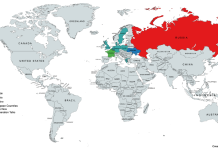
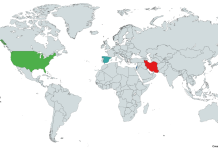
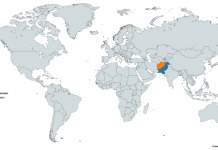
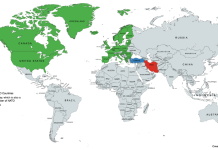
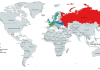
Iran = Red
Saudi Arabia = Green
Kuwait = Blue
Bahrain = Orange
United Arab Emirates = Teal
Qatar = Purple
Image is licensed under the Creative Commons Attribution-Share Alike 4.0 International license and was created using MapChart (https://mapchart.net).