The Federal Reserve opted last Wednesday(1/28/26) to pause its recent easing campaign, keeping interest rates unchanged as policymakers assess a resilient economy, lingering inflation pressures and an increasingly fraught political environment. The decision ends a series of three consecutive rate reductions and reflects a growing sense among officials that economic conditions no longer demand immediate action.
The Federal Open Market Committee voted to maintain its benchmark rate within a range of 3.5% to 3.75%, a move that aligned with market expectations. In its post-meeting statement, the Fed expressed greater confidence in economic momentum while showing less concern about labor market deterioration. Officials described overall activity as steady, noting that while hiring remains subdued, unemployment appears to have leveled off.
At the same time, inflation continues to run above the central bank’s 2% target. That reality prompted policymakers to remove language from earlier statements that emphasized employment risks over inflation concerns, signaling a more balanced assessment of the Fed’s dual mandate. The shift suggests rate cuts are no longer viewed as a near-term necessity.
Fed Chair Jerome Powell echoed that sentiment during a press conference, saying recent data point to firmer growth and a more stable labor market. Inflation, he added, has evolved largely as expected. Powell emphasized that future policy decisions will depend on how economic conditions develop, rather than following a preset path.
Two Fed governors, Christopher Waller and Stephen Miran, dissented from the decision, preferring another quarter-point cut. Both were appointed by President Donald Trump, and Miran’s term expires at the end of the week. Their objections highlight ongoing debate within the central bank over whether inflation has cooled enough to justify further easing.
Financial markets responded calmly. Treasury yields moved slightly higher, while major stock indexes finished the session with minimal changes, reflecting investor acceptance that rates may remain unchanged for several months.
The meeting took place amid mounting pressure on the Fed from the White House. Trump has repeatedly criticized Powell for resisting deeper rate cuts and has accused the central bank of restraining economic growth. Powell, whose term as chair ends in May, has publicly stated that a Justice Department investigation into renovations at the Fed’s Washington headquarters is being used as leverage against the institution.
The Fed’s autonomy is also under scrutiny at the Supreme Court, where justices are considering whether Trump acted within his authority when he attempted to remove Governor Lisa Cook. Powell attended the oral arguments, describing the case as essential to preserving public trust in the central bank’s ability to operate free from political influence.
Meanwhile, the economic backdrop remains uneven. Gross domestic product growth has exceeded expectations, while job creation has slowed amid tighter immigration policies. Layoffs remain limited, and unemployment has edged lower in recent months. Inflation has retreated from earlier highs but remains elevated, with tariffs cited by Fed officials as a short-term contributor to price pressures.
With Powell’s departure approaching and no clear timeline for the next policy move, the Fed appears committed to patience, choosing restraint as it navigates economic uncertainty and intensifying political crosscurrents.
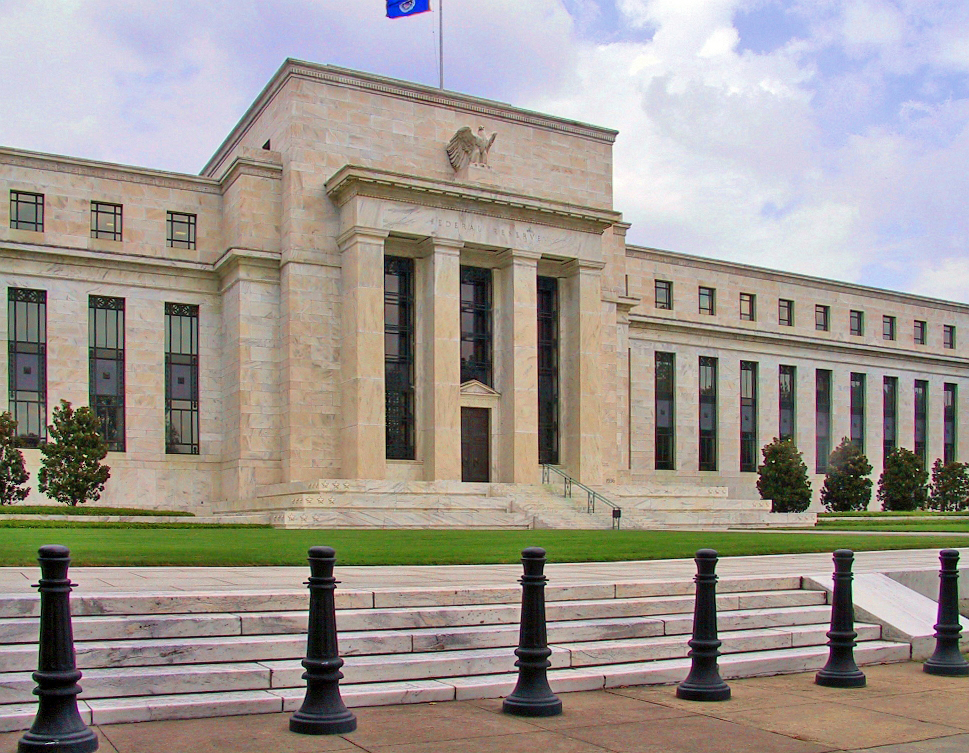
Image is licensed under the Creative Commons Attribution-Share Alike 2.5 Generic license and was created by Rdsmith4.