European Union governments have moved to formally end the bloc’s reliance on Russian natural gas, approving a regulation that will block all remaining imports by the end of 2027. The measure transforms a political commitment made after Russia’s invasion of Ukraine into binding law, setting firm deadlines for the final phaseout of both pipeline gas and liquefied natural gas.
The regulation was approved Monday at a meeting of EU energy ministers in Brussels. While Hungary and Slovakia voted against the measure and Bulgaria abstained, the law was adopted under a reinforced majority mechanism that allowed it to pass without unanimous consent. Hungarian officials have indicated they intend to contest the regulation before the European Court of Justice.
Under the new rules, deliveries of Russian LNG into the European Union must end by the start of 2027. Imports of pipeline gas will be cut off slightly later, with a deadline of September 30, 2027. A limited extension to November 1 of that year is permitted if a member state faces difficulties filling storage facilities ahead of the winter heating season using alternative suppliers.
The legislation also places strict limits on commercial activity tied to Russian gas. Energy companies will be barred from signing new supply contracts with Russian entities. Existing agreements must be wound down according to a defined timetable. Short-term contracts concluded before mid-June 2025 will be prohibited starting in 2026, while long-term arrangements must be terminated entirely before the final cutoff dates. Companies that fail to comply could face fines reaching several percent of their worldwide annual revenue.
To support the transition, EU member states will be required to submit national diversification plans outlining how remaining Russian gas volumes will be replaced. These plans must identify supply risks, infrastructure needs, and alternative sources. Firms importing gas will also be obligated to disclose any outstanding Russian-linked contracts to both national regulators and the European Commission.
The regulation strengthens monitoring of gas entering the EU market by requiring governments to verify the country of production before authorizing imports. Officials say the measure is intended to prevent indirect reentry of Russian gas through intermediaries or blended supply routes.
The law includes an emergency provision allowing the European Commission to temporarily suspend the ban for up to four weeks if energy supply is severely threatened in one or more member states. EU officials stressed that this mechanism is intended as a last resort and does not alter the long-term objective of ending Russian gas dependence.
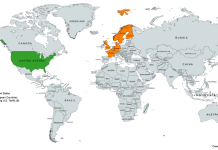
Before 2022, Russia accounted for more than two-fifths of the European Union’s gas supply. That share has dropped sharply in recent years as the bloc expanded imports from Norway and the United States, increased renewable generation, and reduced overall gas consumption. Even so, Russian gas still represents a portion of EU imports, worth billions of euros annually.
European officials say the regulation is part of a broader effort to limit exposure to geopolitical pressure and reduce funding flows tied to Russia’s war effort. The European Commission has signaled that additional proposals are forthcoming, including measures aimed at Russian oil transported by pipeline and steps to reduce reliance on Russian nuclear fuel.
While some governments face a more complex transition than others, the new law establishes a clear legal framework that commits the European Union to completing its shift away from Russian gas within the next two years.
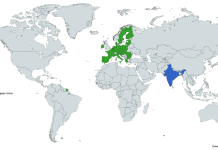
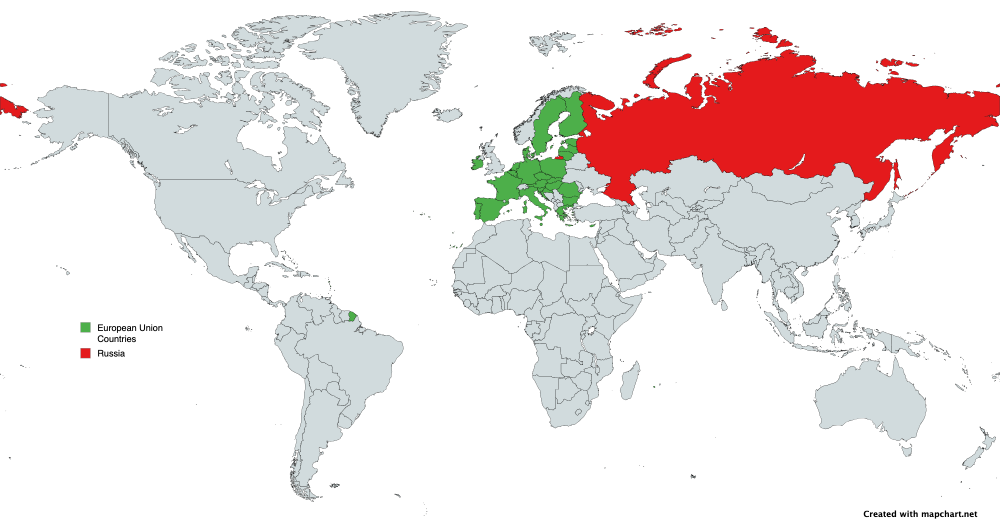
European Union = Green
Russia = Red
Image is licensed under the Creative Commons Attribution-Share Alike 4.0 International license and was created using MapChart (https://mapchart.net).