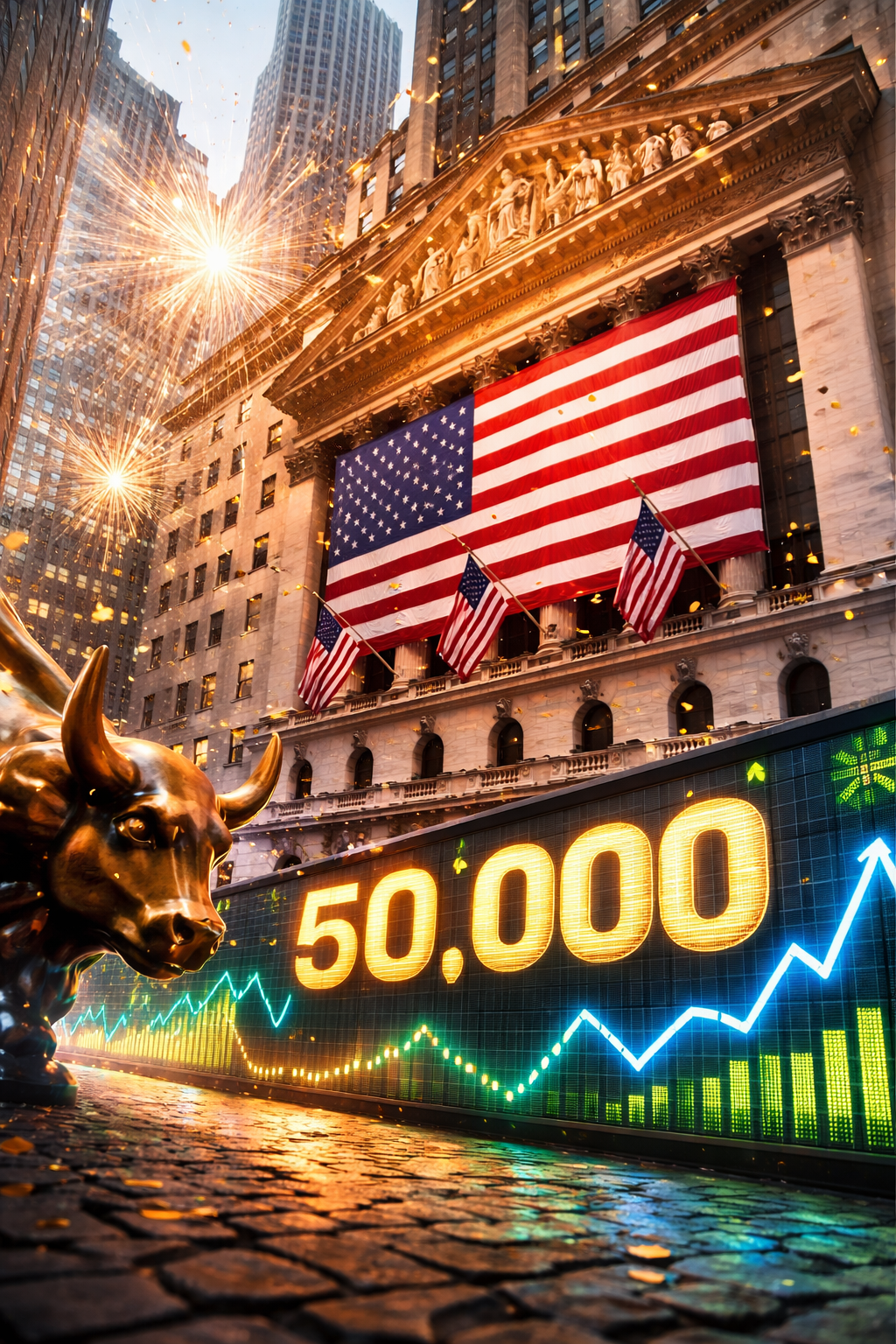
The Dow Jones Industrial Average crossed the 50,000 mark for the first time on Friday, extending a rise that has unfolded over more than a century. The moment drew attention from investors and market watchers, even though round numbers do not change how the market functions. The index climbed more than 1,200 points in a single session to close above the new level, recovering after a recent period of unease on Wall Street.
The Dow began in 1896 when Charles Dow created it with 12 industrial companies as a way to track the health of the U.S. economy. Over time, its makeup has shifted to reflect changes in business and technology. By 1928, the index had expanded to 30 companies, where it remains today. While it still carries the name “industrial,” the Dow now includes firms from sectors such as technology, finance, retail, and health care.
The group of companies in the index has never been fixed. As industries rise and fall, companies are added and removed. In recent years, technology firms have gained a larger presence, mirroring their growing influence in the wider market. A committee at S&P Dow Jones Indices selects which companies are included, looking at a firm’s reputation, long-term performance, and role in the economy.
Friday’s advance came after a shaky stretch for equities. The Dow’s rise ended a three-week losing streak, while the S&P 500 and Nasdaq also posted strong gains for the day, even though both indexes finished the week lower overall. Chipmaker Nvidia helped drive the rally, jumping nearly 8% as demand for artificial intelligence hardware remained strong. Caterpillar shares also moved higher, adding to the index’s climb.
Not every stock joined the rally. Amazon fell sharply after a disappointing earnings report, and Stellantis dropped steeply following news of a business reset and a multibillion-dollar charge. Across the broader market, some companies surged on earnings news while others sank, showing that investor sentiment remains mixed.
The 50,000 level is just the latest marker in the Dow’s long history. In 1972, the index crossed 1,000 for the first time, an achievement that once seemed hard to imagine. At that time, the index was dominated by industrial and manufacturing names, including companies that have since been acquired or faded away. A few, like Procter & Gamble and Chevron, remain part of the lineup decades later.
Despite the attention the Dow receives, it is only one way to view the market. It tracks just 30 companies and is price-weighted, meaning higher-priced stocks have more influence on its movements. By comparison, the S&P 500 covers hundreds of companies and is often seen as a broader gauge.
The recent rally has unfolded against a complex economic backdrop. Federal Reserve officials have offered differing views on the outlook, with some pointing to stability in the job market and others noting that households feel uncertain about the months ahead. Meanwhile, tech giants continue to spend heavily on artificial intelligence, raising questions about costs and future returns.
For now, the Dow’s climb past 50,000 stands as another chapter in its long journey. It reflects shifts in the economy, changing industries, and the ongoing evolution of the companies that shape the market.
This image is the property of The New Dispatch LLC and is not licenseable for external use without explicit written permission.