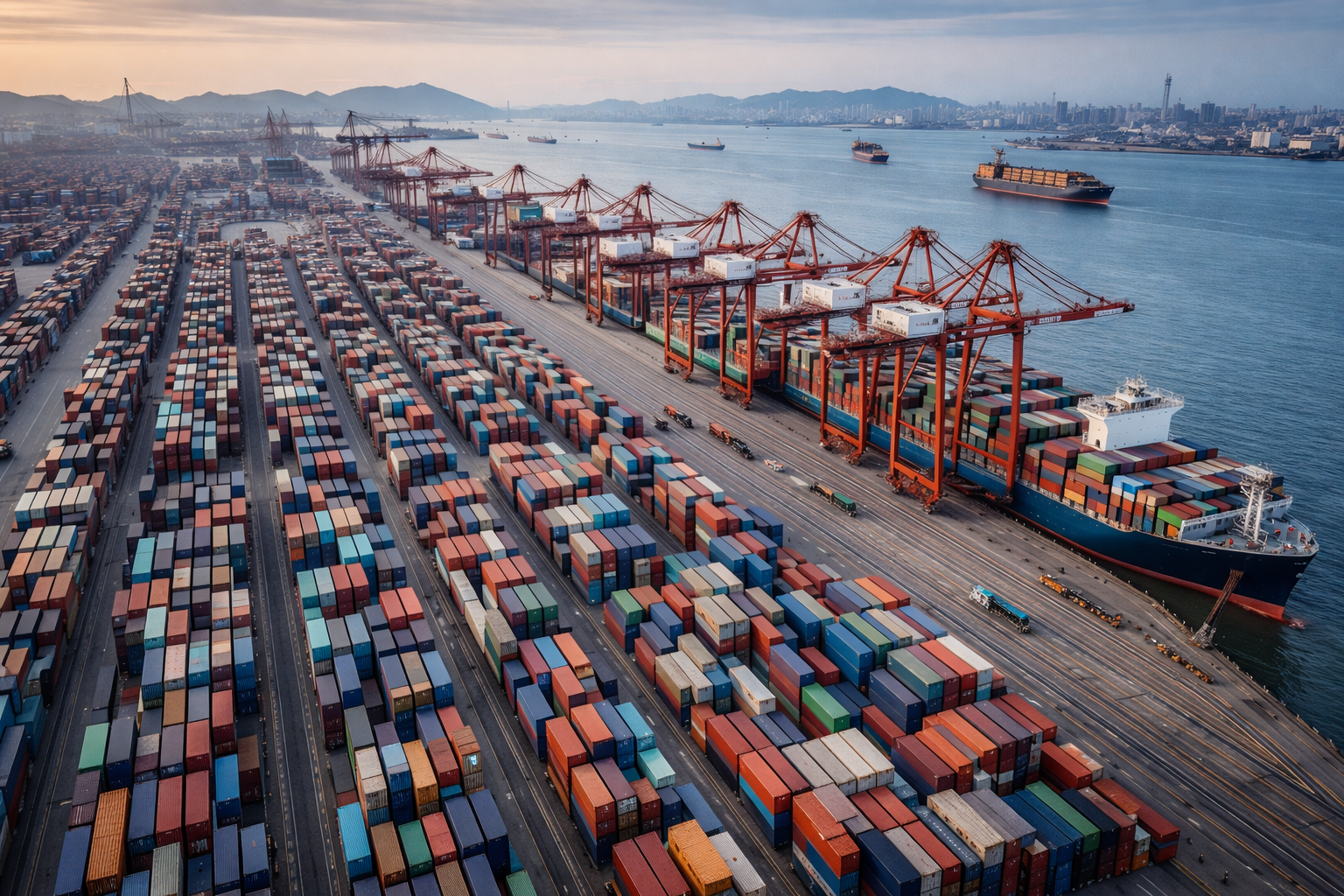
China closed 2025 with a trade surplus of roughly $1.2 trillion, the largest on record, defying expectations that renewed U.S. tariffs would sharply curtail its export machine. Data released by China’s General Administration of Customs show that while shipments to the United States dropped steeply, Chinese exporters compensated by redirecting goods to a wider range of global markets and by moving up the value chain.
Exports to the U.S., once China’s single biggest country-level trading partner, fell by more than 20% last year as tariffs imposed by President Donald Trump’s administration made Chinese goods less competitive. Imports from the U.S. also declined, reflecting both trade barriers and Beijing’s drive to reduce dependence on foreign suppliers in sensitive sectors. Even so, overall exports grew more than 6%, while imports were largely flat, producing a widening surplus.
The gap was filled by rising trade with other regions. Shipments to Africa surged more than 25%, while exports to Southeast Asia, the European Union, and Latin America all posted solid gains. Chinese customs officials emphasized that this broader geographic spread has reduced reliance on any single market. Analysts say Chinese firms have adapted quickly, using alternative routes, new logistics networks, and overseas production hubs to bypass high U.S. duties.
Equally important has been a shift in what China sells abroad. Exports of higher-end products such as automobiles, electric vehicles, semiconductors, and industrial machinery rose sharply, while shipments of lower-margin consumer goods like toys and footwear declined. China’s auto sector stood out, with vehicle exports climbing nearly 20% and electric vehicle shipments jumping far faster. Exports of rare-earth minerals, a strategic resource, also rose to their highest level in more than a decade.
Inside China, the surplus reflects weak domestic demand. A prolonged property slump and cautious consumers have kept import growth subdued, even as factories continued to run at high capacity. Beijing has leaned on exports to stabilize growth, but that approach has raised concerns abroad. Economists warn that an economy as large as China’s cannot rely indefinitely on external demand without fueling trade frictions, especially as other countries struggle to absorb a flood of competitively priced Chinese goods.
The trade data had immediate market effects. Stock indexes in mainland China and Hong Kong climbed after the release, with investors taking comfort in exporters’ resilience. A weaker yuan also helped support overseas sales, making Chinese products cheaper in foreign markets.
Tensions with Washington remain unresolved. Although Trump and Chinese President Xi Jinping agreed last year to extend a tariff truce, U.S. duties on Chinese goods remain close to 50%, well above levels many analysts believe allow exporters to earn profits. Chinese officials argue that restrictions on high-tech exports to China have inflated the surplus by limiting imports.
Looking ahead, Beijing has signaled some awareness of the imbalance. Senior leaders have spoken about expanding imports and promoting more balanced trade, and policymakers have begun rolling back certain export incentives, particularly in sectors that have drawn criticism from Europe and the U.S. Whether those steps will ease global unease remains uncertain. For now, China’s 2025 trade figures show an export engine that has proven adaptable, even in a far less welcoming trade environment.
This image is the property of The New Dispatch LLC and is not licenseable for external use without explicit written permission.