China’s CATL has begun construction of what is set to become Spain’s largest battery plant, launching a project that blends global industrial cooperation with Europe’s push to expand its electric-vehicle supply chain. At a ceremony in Figueruelas, a small town in northeastern Spain, executives from CATL and automotive group Stellantis outlined plans for a €4.1-billion venture that will bring advanced battery manufacturing to a region eager to strengthen its role in the EV transition.
Backed by more than €300 million in European Union funds, the plant marks China’s largest investment in Spain to date. Despite ongoing tensions between Brussels and Beijing over trade rules, Chinese representatives emphasized that they intend to share expertise with Europe. CATL officials described battery manufacturing as a field that requires years of accumulated knowledge and said the company aims to make its technology accessible to partners and workers across the continent.
Spain, already Europe’s second-largest car producer, sees the factory as part of a broader effort to develop a homegrown battery ecosystem. Lower labor costs and industrial energy prices around 20% below the EU average give the country an advantage as it seeks to host new facilities. Several other battery projects—proposed by Envision AESC, Volkswagen’s PowerCo, and InoBat—are also planned. Yet local industry groups acknowledge that Spain lacks deep experience in battery engineering. Many suppliers and union officials say that learning from Chinese experts will be essential in the early years.
The Figueruelas plant is expected to begin operations in late 2026, supplying Stellantis factories across Spain, including one located adjacent to the site. During construction, unions estimate that around 2,000 Chinese workers may be involved, though CATL says subcontractors are still being selected and hiring plans have not been finalized. Once the facility moves into production, around 3,000 Spanish employees will be trained to take on technical and operational roles. CATL and Stellantis intend to partner with universities and bring Spanish staff to China for hands-on instruction. Over time, the proportion of Chinese personnel is expected to fall below 10%.
Local workers see the project as a major opportunity for job creation and skill development. Union leaders stress that for the venture to thrive, cooperation between Spanish and Chinese teams will be crucial. Community reactions reflect a pragmatic view: Spain has long depended on foreign automotive technology, first from German manufacturers and now increasingly from Chinese companies. As one Stellantis manager noted, the country has traditionally contributed strong labor capacity, and the new plant will expand that contribution into more specialized areas.
Beyond Spain, the project also fits into a wider pattern. With the EU imposing tariffs on electric vehicles built in China, several Chinese companies—including EV makers and suppliers—are accelerating their push to build inside Europe. Producing batteries locally helps stabilize supply chains, supports job creation, and aligns with European industrial goals.
With a planned annual output of 50 GWh and billions in investment, the Figueruelas factory represents a major step in Europe’s efforts to expand EV infrastructure while adapting to a fast-changing global industry.
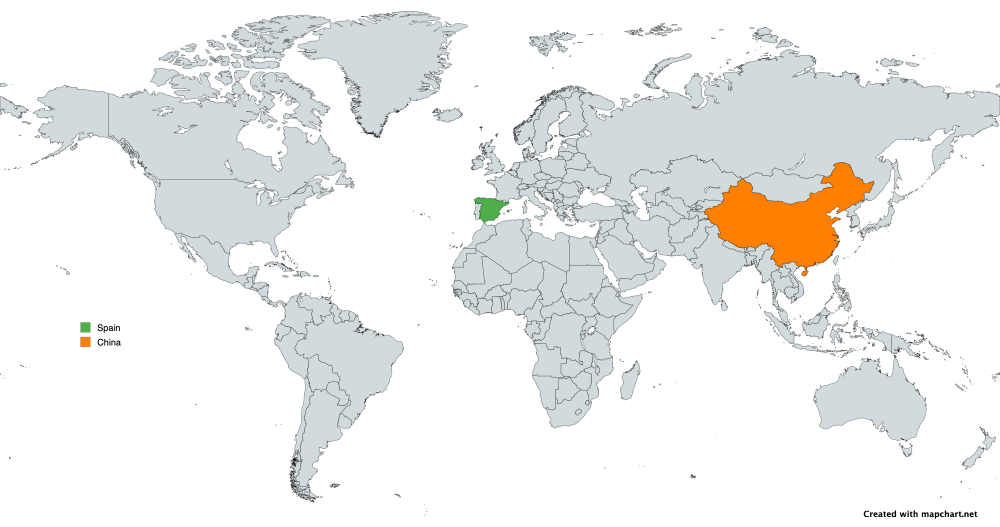
Green = Spain
Orange = China
Image is licensed under the Creative Commons Attribution-Share Alike 4.0 International license and was created using MapChart (https://mapchart.net).