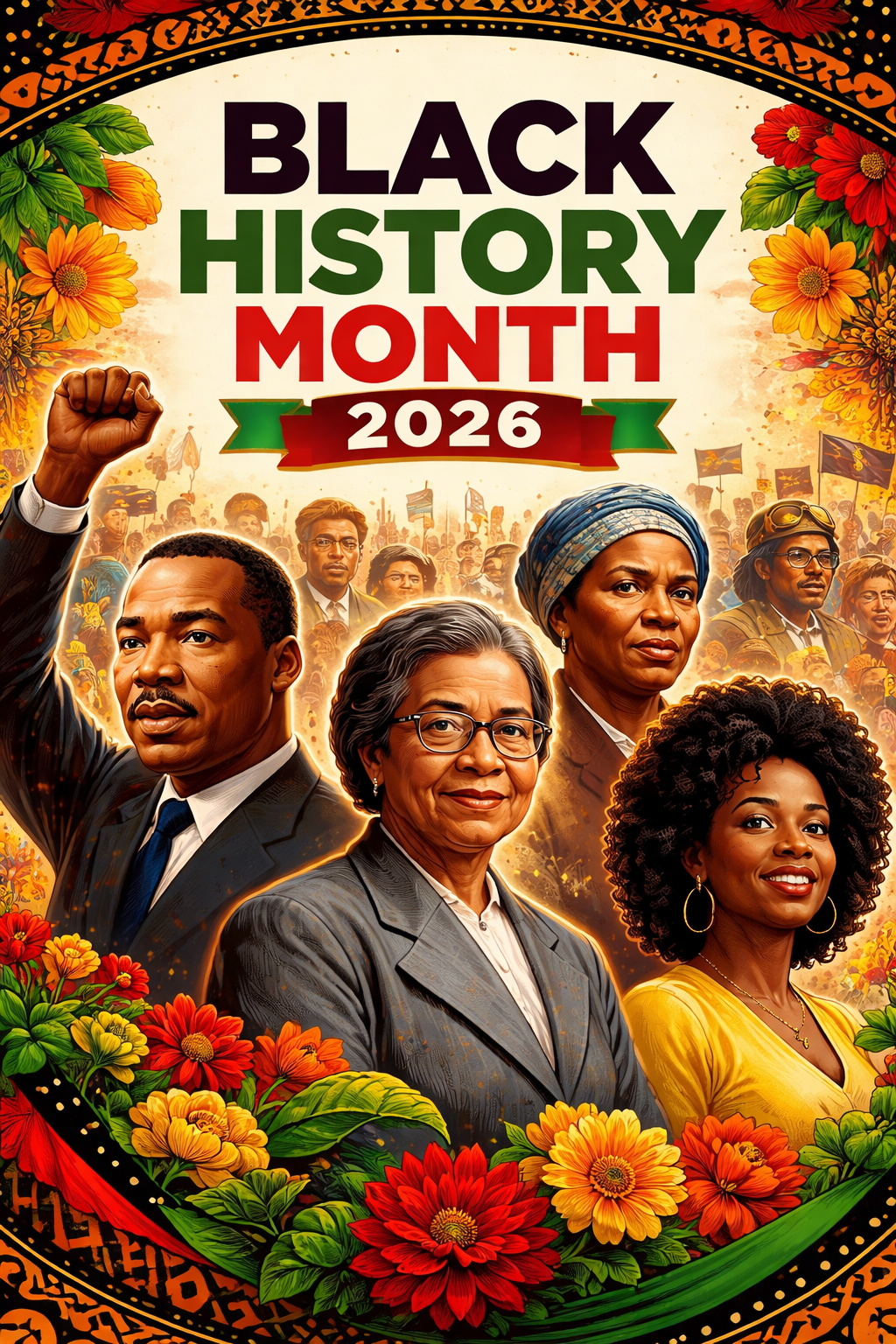
Black History Month is observed each February in the United States and Canada as a period dedicated to examining the history, achievements, and cultural impact of people of African descent. Rather than functioning solely as a celebration, the observance also encourages public engagement with difficult historical realities and ongoing debates about equity, representation, and justice.
The roots of Black History Month extend back to the early twentieth century. In 1926, historian Carter G. Woodson introduced what was then called Negro History Week. Woodson had co-founded the Association for the Study of Negro Life and History to promote the scholarly study of Black life and history at a time when such work was largely excluded from academic institutions and public education. He believed that a society unable to accurately understand its past could not meaningfully address its present or future.
The week chosen for this observance fell in mid-February, aligning with longstanding community commemorations connected to Abraham Lincoln and Frederick Douglass. These dates already held symbolic importance within Black communities, and Woodson intentionally anchored his initiative in traditions that were already familiar and respected.
At first, Negro History Week relied heavily on grassroots participation. Black educators, churches, civic groups, and newspapers played a central role in organizing lectures, publishing historical essays, and highlighting notable individuals and events. Over time, the observance expanded beyond Black institutions. By the middle of the twentieth century, it had gained wider acceptance in public schools and libraries, though often through the efforts of individual teachers rather than formal policy.
As the social movements of the 1950s and 1960s reshaped American political and cultural life, interest in African American history grew substantially. College students and faculty, particularly at historically Black colleges and universities, began pushing for broader curricular inclusion and longer periods of recognition. In many places, the one-week observance gradually evolved into a month-long focus.
This shift received national visibility in 1976, when the federal government formally acknowledged February as Black History Month during the U.S. Bicentennial year. Then-President Gerald Ford encouraged Americans to engage more fully with historical contributions that had long been overlooked in mainstream narratives. From that point forward, annual presidential acknowledgments helped establish the observance as a regular feature of civic life in the United States.
Black History Month later gained official recognition in other countries. Canada designated February for this purpose at the federal level in 1995, following years of advocacy by Black Canadian organizations and lawmakers. In the United Kingdom, the observance takes place in October and began in 1987, initiated by Akyaaba Addai-Sebo and supported by local governments and community groups in London. Comparable observances have since developed in Ireland, the Netherlands, and other parts of Europe.
A defining feature of Black History Month in the United States is the annual theme selected by the Association for the Study of African American Life and History. These themes are designed to encourage deeper exploration of particular topics, such as political activism, cultural production, labor history, or health, and they help shape educational programming nationwide.
In practice, Black History Month highlights both widely recognized figures—such as Harriet Tubman, W.E.B. Du Bois, Rosa Parks, Martin Luther King Jr., Malcolm X, and Maya Angelou—and the many lesser-known individuals whose work shaped local communities, institutions, and social movements.
At the same time, the observance creates space to address present-day concerns, including racial disparities in education, healthcare, employment, voting access, and the criminal justice system. Museums, schools, libraries, workplaces, and cultural organizations use the month to host exhibitions, discussions, and public programs that connect historical understanding to contemporary challenges.
Nearly one hundred years after its original conception, Black History Month continues to evolve. Its lasting significance lies not only in remembering the past, but in encouraging informed dialogue, critical thinking, and sustained attention to the unfinished work of equality.
This image is the property of The New Dispatch LLC and is not licenseable for external use without explicit written permission.