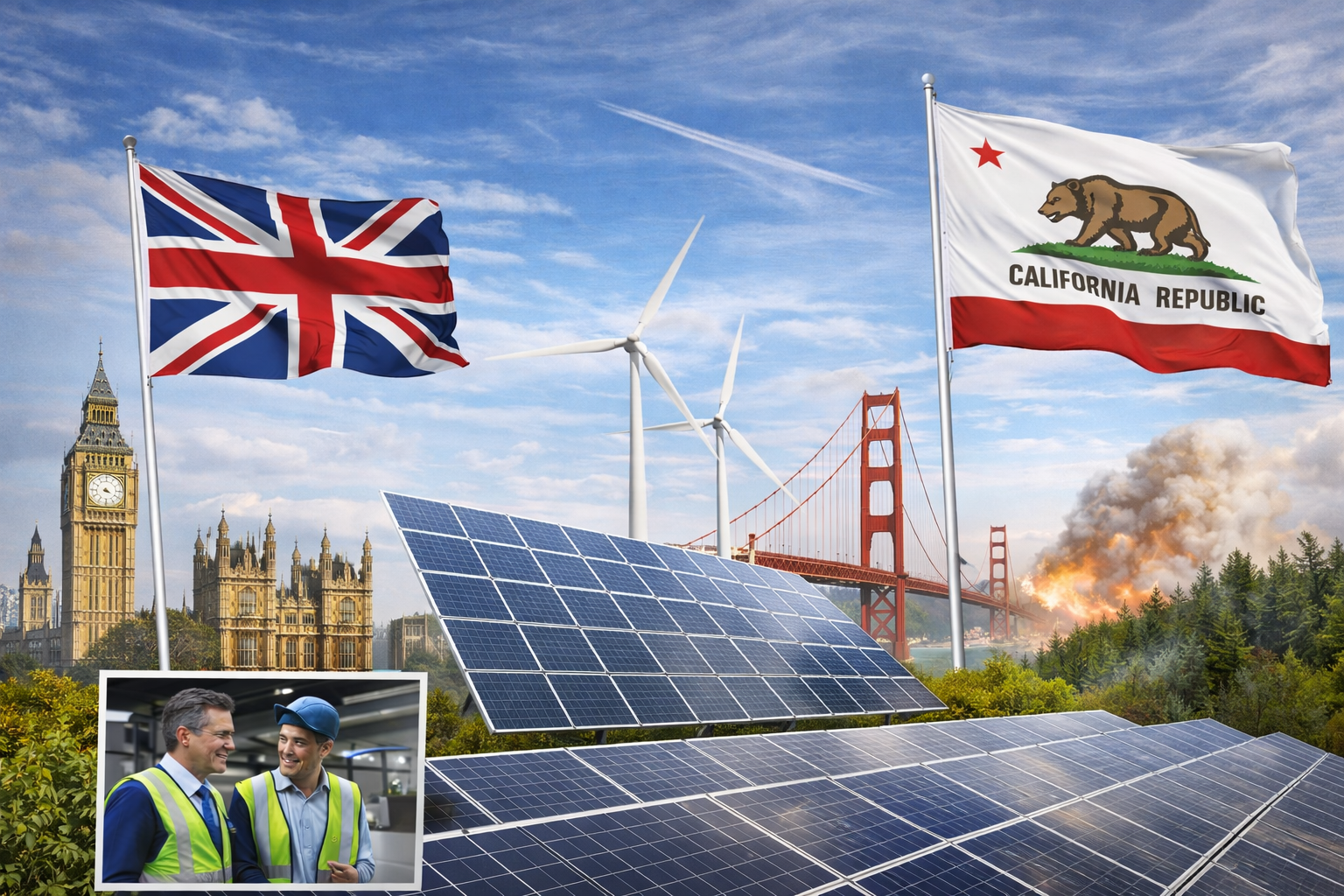
California Governor Gavin Newsom’s recent visit to London marked a new phase in cooperation between California and the United Kingdom on climate and clean energy. During the trip, Newsom met with government officials and business leaders to strengthen ties focused on sustainability, trade, and innovation. A central outcome of the visit was the signing of a Memorandum of Understanding with U.K. Energy Secretary Ed Miliband, aimed at expanding collaboration on climate action and sustainable development.
The agreement builds on an existing relationship between California and the United Kingdom, with both partners working to address environmental challenges through policy coordination, research, and private sector engagement. The memorandum outlines plans to accelerate innovation in clean energy, support carbon reduction strategies, and share best practices for dealing with issues such as extreme weather, wildfires, and rising costs tied to climate change. Leaders from both sides said the partnership would create opportunities for businesses while advancing efforts to reduce emissions and transition toward cleaner power sources.
Newsom’s visit concluded with a stop at the headquarters of Octopus Energy, a British clean technology company that announced it would invest nearly $1 billion in California-based projects. The funding will support companies working on clean energy, carbon removal, and nature-based solutions such as reforestation and land restoration. Company leaders said California’s clear climate policies, strong technology sector, and stable investment environment made it an attractive place to expand their international presence. The investment is expected to support innovation while helping to build long-term economic links between the two regions.
California officials have emphasized that partnerships like this are part of a broader strategy to position the state as a leader in the transition to a cleaner economy. Over the past two decades, California has reduced greenhouse gas emissions while continuing to grow economically. State leaders point to expanding battery storage, increased renewable energy generation, and strong market incentives as key factors driving investment and job creation.
The state has also developed climate partnerships around the world, including agreements with Chile, Colombia, Nigeria, and Brazil. These collaborations focus on areas such as methane reduction, forest protection, sustainable transportation, and clean energy development. California has worked with international partners to share research, create pilot programs, and strengthen environmental monitoring efforts.
Beyond individual agreements, California has helped build coalitions that bring together regional governments to address climate challenges. Through groups like the U.S. Climate Alliance and international initiatives aimed at cutting methane emissions and reducing dependence on fossil fuels, the state has maintained a presence in global climate discussions even as federal priorities have shifted over time.
The new partnership with the United Kingdom has also drawn political attention. Former President Donald Trump criticized the agreement and Newsom personally, calling the arrangement inappropriate and attacking California’s environmental policies. A spokesperson for Newsom responded by defending the state’s climate agenda and stating that international partners are increasingly interested in working with California on clean energy and environmental solutions.
Despite political tension, leaders in both California and the United Kingdom say the agreement offers a path to strengthen clean energy markets, create jobs, and expand access to new technologies. With rising demand for low-carbon solutions, both regions view collaboration as a way to accelerate progress while supporting economic growth.
This image is the property of The New Dispatch LLC and is not licenseable for external use without explicit written permission.