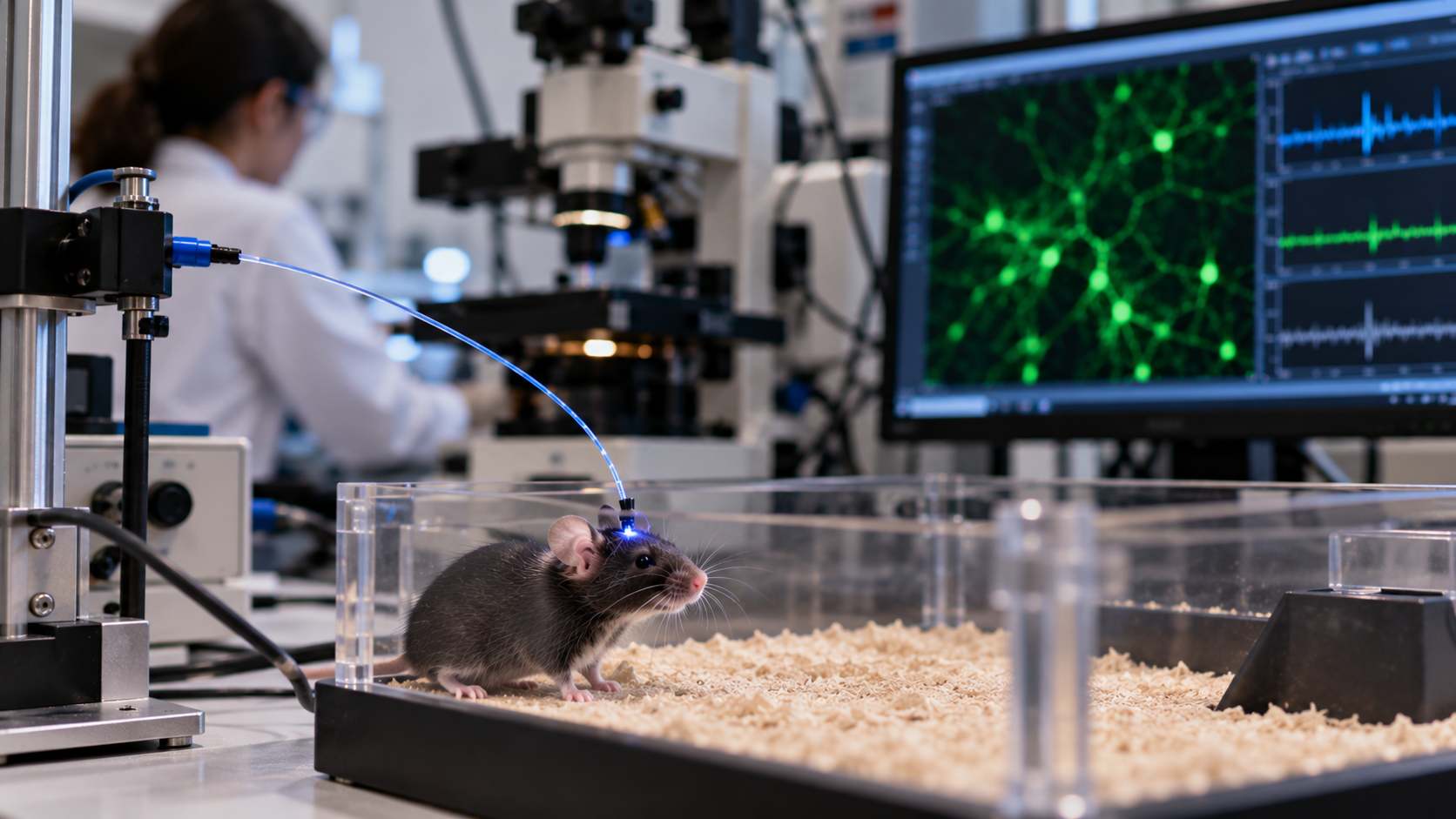
Scientists can make a sleeping mouse wake up by shining light on specially prepared cells in its brain. They can also trigger movement in a mouse’s whiskers. Those experiments are examples of what became possible through optogenetics, the research behind this year’s Nobel Prize in Physiology or Medicine.
The 2026 award is going to Karl Deisseroth, Peter Hegemann and Georg Nagel. Their discoveries provided researchers with a way to choose certain neurons and use light to change their activity.
That gives scientists a different way of asking questions about the brain. If activating a particular collection of neurons causes a response, researchers have another clue about what those cells are doing. The same approach can be used to investigate cells associated with behavior, movement and other functions.
Researchers have put the method to work in animal studies involving several illnesses and disorders. Among them are Alzheimer’s disease, schizophrenia, addiction, epilepsy and Parkinson’s disease. Scientists can examine which cells appear to be involved in these conditions and use those findings to guide further research.
Yet the science behind all of this traces back to algae rather than mice or humans.
Hegemann was interested in how a tiny green alga quickly reacts to light. His research raised the possibility that a protein was responsible for detecting that light while also affecting the movement of ions into or out of a cell. Nagel worked on testing the idea.
That research eventually brought attention to channelrhodopsin-2. The protein responds when illuminated, producing changes in the electrical activity of a cell. Hegemann and Nagel reported in 2003 that this effect could be produced after introducing the protein into other types of cells.
Deisseroth’s contribution took the idea into neuroscience. By 2005, he had demonstrated that the light-based process could work in nerve cells from rats. The term optogenetics came into use the following year.
The research did more than provide another laboratory experiment. It meant scientists could interfere with the activity of chosen neurons at a particular moment and then see what happened.
Researchers are now investigating whether ideas developed through optogenetics might eventually help patients as well. Vision is one area receiving attention. Work is underway to make retinal cells sensitive to light as a possible way of helping people who have lost vision from retinitis pigmentosa.
Hearing research offers another possible use. Scientists are considering whether light could someday be used with cochlear implants to target the auditory nerve more precisely than electrical stimulation does now.
Deisseroth carries out his academic work at Stanford. Hegemann’s work is based at Humboldt University of Berlin. Nagel is based at the University of Würzburg.
There is also a cash award attached to the honor. Its value is 12 million kronor in Swedish currency, equivalent to approximately $1.2 million, and it will be divided among the three scientists. The presentation is scheduled for Dec. 10 in Stockholm.
The medicine announcement starts this year’s series of Nobel awards. Winners in physics, chemistry, literature and peace are scheduled to be announced during the rest of the week.
This image is the property of The New Dispatch LLC and is not licenseable for external use without explicit written permission.