Spain has taken a firm stance in response to the ongoing conflict involving the United States and Iran, announcing the closure of its airspace to U.S. military aircraft connected to the war. The decision, confirmed by Defence Minister Margarita Robles, expands on earlier measures that had already denied U.S. forces access to key joint military bases in southern Spain.
Robles made clear that both the Morón and Rota bases, long used in cooperation with the United States, would not be available for any operations linked to the conflict. She emphasized that this position had been communicated to Washington from the outset. Spain’s leadership has framed the move as part of a broader commitment to avoiding involvement in what it considers an unlawful military campaign.
Foreign Affairs Minister José Manuel Albares reinforced this message, explaining that Madrid’s objective is to prevent any action that might intensify the war. This approach reflects the wider position of Prime Minister Pedro Sánchez, who has been one of the most outspoken European critics of U.S. and Israeli military actions in Iran. Sánchez has repeatedly described the strikes as reckless and contrary to international law, while calling for all parties to de-escalate.
The airspace closure has practical consequences for U.S. operations. Aircraft that would typically pass over Spain must now reroute, either over the Atlantic Ocean or through other European countries such as France. While emergency exceptions remain in place, the restriction complicates logistics for missions originating from bases like RAF Fairford in the United Kingdom.
Spain’s decision has not gone unnoticed in Washington. A White House official stated that U.S. forces are continuing to meet their objectives without external assistance. However, tensions between the two allies have grown. President Donald Trump has previously threatened trade measures against Spain in response to its refusal to support the military campaign.
Criticism has also come from U.S. Secretary of State Marco Rubio, who questioned the balance of obligations within the NATO alliance. He suggested that denying access to bases and airspace could prompt a reassessment of the relationship, particularly given the U.S. role in European defense.
Despite the pressure, Spain has maintained that its actions are rooted in sovereignty and adherence to international law. Officials have pointed to past instances where NATO members diverged on military cooperation, noting that alliance membership does not eliminate independent decision-making.
The move also reflects broader unease among some European governments regarding the direction of U.S. foreign policy. While many countries remain cautious about openly opposing Washington, Spain has taken a more visible stance. Analysts suggest that others may hesitate to follow suit, especially given the importance of U.S. support in areas such as Ukraine.
Beyond military considerations, the conflict has had global economic implications. The Strait of Hormuz, a critical النفط shipping route near Iran, has faced disruptions, contributing to rising oil prices. Spain’s diplomatic posture, including its communication with Iranian officials, indicates an effort to balance political principles with practical concerns about energy and regional stability.
In closing its airspace, Spain has signaled a clear refusal to participate in the conflict, even indirectly. The decision highlights the ongoing strain within transatlantic relations and raises questions about how alliances will function when member states disagree on matters of war and peace.
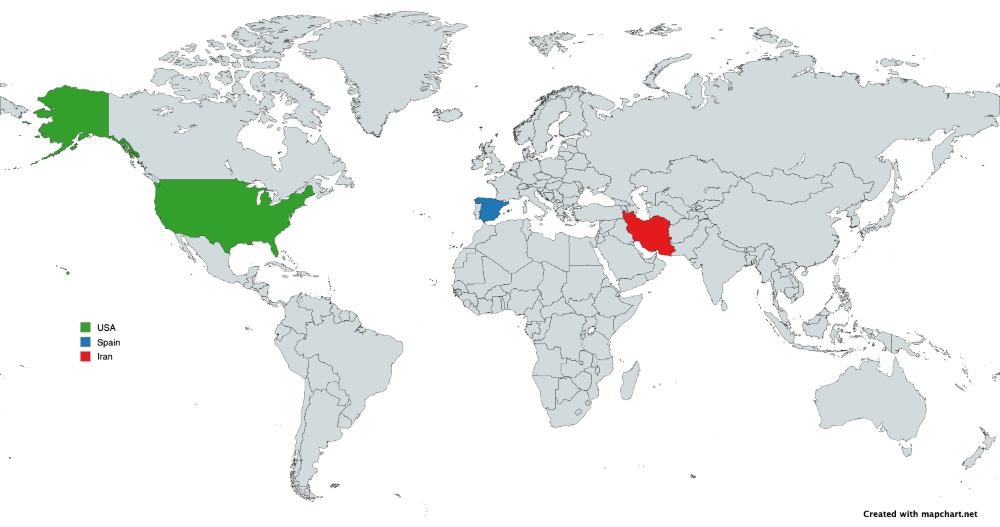
USA = Green
Spain = Blue
Iran = Red
Image is licensed under the Creative Commons Attribution-Share Alike 4.0 International license and was created using MapChart (https://mapchart.net).