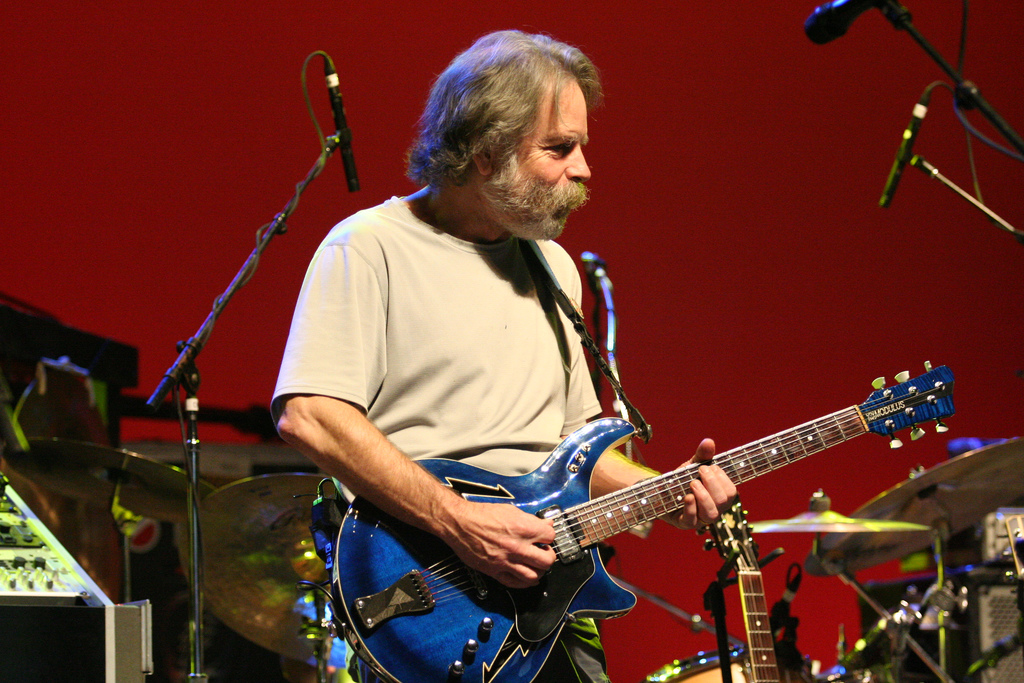
For more than sixty years, Bob Weir stood at the center of one of American music’s most enduring experiments, shaping the sound of the Grateful Dead through an approach to rhythm guitar that defied convention. On January 10, 2026, that long musical journey came to a close. Weir was 78. His death was confirmed by his family.
Weir was born Robert Hall Parber on October 16, 1947, in San Francisco and was adopted as a child. As a teenager, he met Jerry Garcia in Palo Alto, an encounter that led to the formation of a band that would soon abandon traditional structures in favor of collective improvisation. Along with Garcia, Phil Lesh, Ron “Pigpen” McKernan, and Bill Kreutzmann, Weir helped assemble what became the Grateful Dead, a group that reimagined the relationship between performer and audience.
Rather than anchoring songs with predictable chord patterns, Weir treated the guitar as a rhythmic and harmonic counterweight. His playing often moved independently of the lead line, weaving fragments, accents, and unexpected voicings through the music. That method gave the Dead’s extended performances a sense of motion and tension, allowing the band to explore freely without losing coherence.
Weir’s role as a songwriter and vocalist further expanded the band’s palette. Working with lyricists such as Robert Hunter and John Perry Barlow, he helped introduce songs that blended narrative, reflection, and humor into the Dead’s repertoire. Pieces like “Sugar Magnolia,” “Playing in the Band,” and “Jack Straw” became recurring landmarks in live performances, shaped anew each night.
After the death of Jerry Garcia in 1995, Weir continued to perform and reinterpret the music through a series of projects, including RatDog and Furthur. In 2015, he helped launch Dead & Company, a group that brought the Grateful Dead catalog to audiences who had never seen the original band. Extensive touring over the next several years reaffirmed the durability of the music and its ability to connect across generations.
Outside the group setting, Weir released solo work at various points in his career, beginning with Ace in 1972 and continuing decades later with Blue Mountain. He also devoted time and resources to philanthropic efforts, co-founding the Rex Foundation and supporting initiatives tied to environmental stewardship and arts education.
According to his family, Weir died peacefully at home following a period of declining health. His final public performances took place in August 2025 during concerts in San Francisco commemorating the Grateful Dead’s 60th anniversary.
He is survived by his wife, Natascha Münter, and their two daughters.
Bob Weir leaves behind a body of work defined not by repetition, but by curiosity and risk. Through thousands of performances and countless reinventions, he helped create a musical language that continues to evolve long after the final note fades.
Image is licensed under the Creative Commons Attribution-Share Alike 2.0 Generic license and was created by minds-eye.







.jpg)